March 13th, 2026
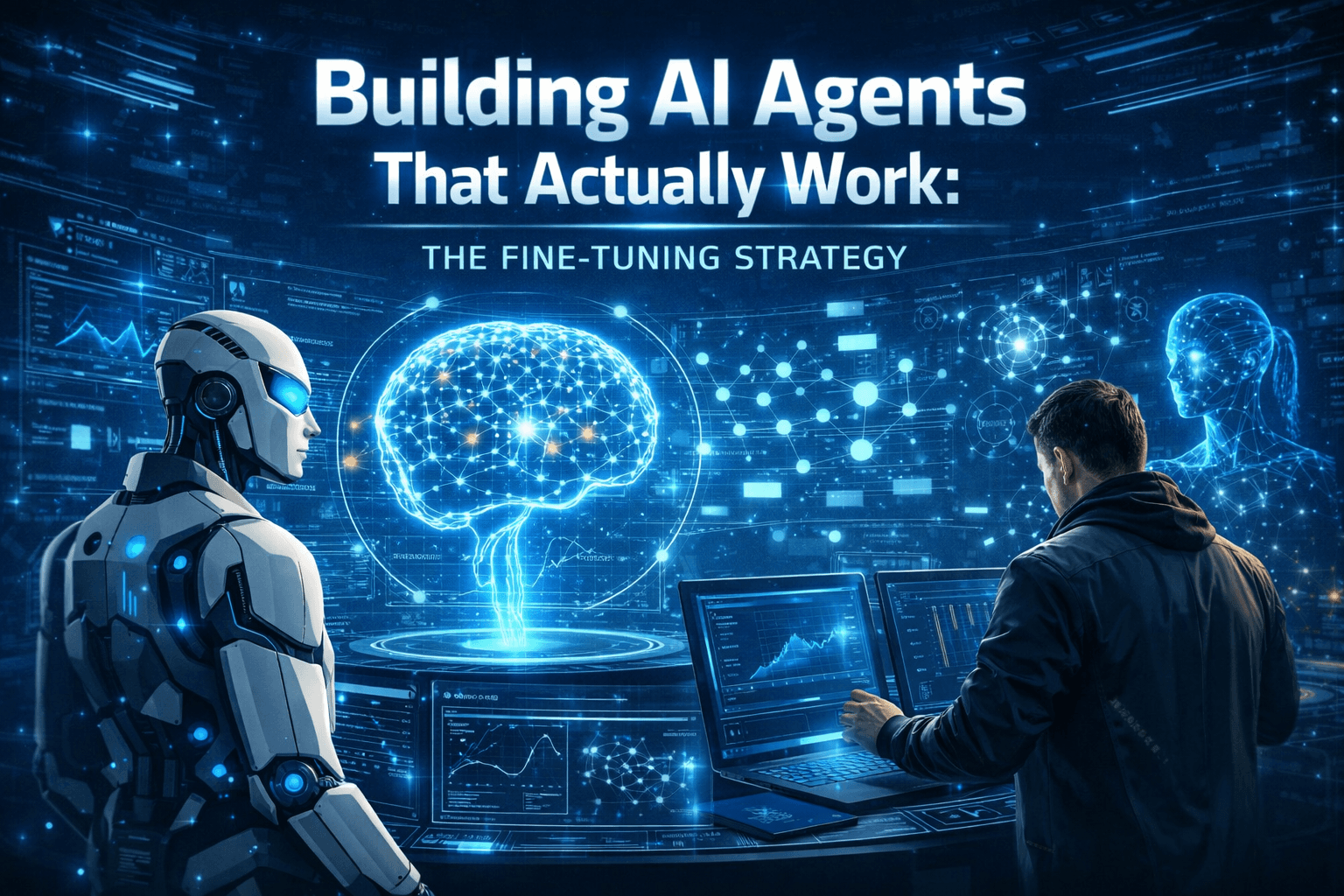
Building AI Agents That Actually Work: The Fine-Tuning Strategy
Everyone builds their first AI agent the same way.
They start with prompt engineering, a carefully crafted system prompt, a few-shot examples, maybe some reasoning instructions. For a while, it works.
Until it doesn’t.
The agent calls the wrong tool. It hallucinates API arguments. It loops endlessly when it should stop. Or worse, it answers confidently when it should say “I don’t know.”
At that point most teams double down on prompting: longer instructions, more examples, additional guardrails.
But there is a ceiling to what prompting can achieve.
Beyond that ceiling lies fine-tuning the process that transforms a generic language model into a reliable, domain-specific AI agent.
Fine-tuning is not a quick fix. It is a structured engineering process that requires high-quality data, careful training, and rigorous evaluation. When done correctly, it produces agents that are more reliable, efficient, and aligned with real-world workflows.
Why Base LLMs Struggle as AI Agents
Large language models are trained to predict the next token based on previous text. Their training data includes books, code, websites, and documentation.
This gives them strong general reasoning ability but agent behavior is very different from text generation.
Agents must plan, act, observe results, and adapt. Base models are not trained for these behaviors.
This leads to several common issues.
Tool Usage Problems
Pretraining data contains very little structured tool-call syntax.
As a result, models frequently generate tool calls that:
- wrong parameters
- hallucinated arguments
- missing required fields
A response may look correct but fail when executed by software.
Task Completion Logic
Agents operate in iterative workflows:
Plan → Act → Observe → Repeat
Knowing when to stop requires understanding whether the task is completed something next-token prediction does not naturally capture.
Models often:
- over-iterate
- terminate too early
- repeat redundant steps
Error Recovery Is Weak
When a tool returns an error like a 404 response or malformed query many agents fail to diagnose the issue.
Instead they either:
- repeat the same broken tool call
- collapse into apology mode
- produce fabricated answers
Miscalibrated Confidence
Language models are often overconfident in uncertain scenarios.
For agents executing real-world actions, this creates risk:
- unnecessary tool usage
- incorrect task completion
- false assumptions presented as facts
Fine-tuning addresses these problems directly.
Prompting tells the model what to do. Fine-tuning changes what the model wants to do.
What Is Agentic AI?
Agentic AI refers to systems capable of autonomously completing multi-step tasks rather than simply responding to prompts.
A typical AI agent consists of four layers:
1. LLM Reasoning Engine: Generates plans, reasoning, and decisions.
2. Tool Layer: APIs, search systems, databases, code execution, or external software.
3. Memory Layer: Stores context from previous interactions and long workflows.
4. Execution Loop: The agent repeatedly performs:
Enterprises are rapidly building agent-first architectures where AI systems interact with software, research information, and automate workflows.
But without proper training, these systems remain unreliable.
This is where agentic fine-tuning becomes essential.
The Agent Fine-Tuning Pipeline
Fine-tuning an AI agent typically follows a structured pipeline.
1. Trace Collection
Training begins with collecting agent trajectories, also known as traces.
A trace represents a full agent interaction:
Goal → Reasoning → Tool Calls → Observations → Final Answer
These examples teach the model how effective agents behave.
High-quality data is critical. 1,000 strong traces are often better than 10,000 weak ones.
2. Supervised Fine-Tuning (SFT)
In this stage, the model learns to imitate high-quality traces.
The training data teaches the model:
- how to structure reasoning
- when to use tools
- how to execute workflows
- how to produce final responses
This stage establishes the baseline behavior of the agent.
3. Preference Alignment
Even well-trained agents can produce suboptimal workflows.
Preference training methods such as DPO(Direct Preference Optimization) or ORPO (Odds Ratio Preference Optimization) teach the model to prefer better behaviors over weaker ones.
Training data includes:
- Prompt
- Chosen trajectory
- Rejected trajectory
The model learns to distinguish correct workflows from flawed ones.
Many modern pipelines use ORPO, which combines supervised learning and preference alignment in a single training stage.
4. Evaluation and Iteration
Fine-tuning does not end with training.
Successful teams continuously improve their agents through a loop:
Collect failures → Improve dataset → Retrain → Evaluate → Deploy
Organizations that succeed with agentic AI run this cycle regularly rather than treating fine-tuning as a one-time event.
Building High-Quality Training Data
The dataset is the most important part of the fine-tuning process.
Strong datasets typically come from three sources.
Expert Demonstrations
Human experts perform tasks manually while documenting reasoning and tool usage.
These are expensive but extremely valuable training examples.
Frontier Model Distillation
Advanced models generate traces which are then filtered for correctness before being used as training data.
Production Logs
Successful episodes from existing agents can be extracted from logs and reused as training examples.
These examples are often the most realistic and domain-relevant.
Training Agents to Use Tools Correctly
Tool usage is one of the hardest parts of building agents.
Training datasets should include:
Successful tool calls – demonstrating correct parameters and usage.
Tool failures – teaching the agent how to recover from errors.
Tool refusal cases – situations where calling a tool is unnecessary.
Agents trained on these scenarios learn to use tools more intelligently and reliably.
Efficient Fine-Tuning Methods
Training large models can be expensive, but modern techniques reduce the hardware requirements.
QLoRA:
Quantizes the base model and trains low-rank adapters.
This allows large models to be fine-tuned on limited hardware.
DoRA:
Separates weight updates into magnitude and direction.
This approach often achieves quality closer to full fine-tuning.
QDoRA:
Combines quantization and DoRA for high efficiency.
This method is emerging as the quality-to-compute sweet spot for many production systems.
These approaches allow organizations to fine-tune powerful models with significantly fewer resources.
Evaluating AI Agents
Agent evaluation requires more than traditional LLM benchmarks.
Important metrics include:
Task Success Rate – whether the agent completes the goal correctly.
Trajectory Efficiency – number of tool calls or reasoning steps used.
Failure Mode Analysis – understanding where the agent fails.
Evaluation should always compare the fine-tuned model against the base model to ensure improvements do not introduce regressions.
Mistakes to Avoid
Several mistakes frequently appear in early-stage agent systems.
1. Training on Unverified Traces
Even a small contamination rate can cause agents to learn incorrect behaviors confidently.
2. Ignoring Catastrophic Forgetting
Fine-tuning on a narrow domain can cause the model to forget broader capabilities.
Always evaluate on general benchmarks alongside domain tasks.
3. Evaluating Only on Training Distribution
If evaluation tasks mirror training tasks, you are measuring memorization, not generalization.
Include novel task phrasing and edge cases.
4. Skipping Prompt Engineering First
A good prompt establishes the behavioral baseline.
Without it, you cannot measure what fine-tuning actually improved.
5. Treating It as a One-Time Event
As your product evolves, your agent’s failure modes evolve.
Build a continuous improvement loop:
Collect failures → Add to dataset → Retrain → Evaluate → Deploy
The best teams run this cycle quarterly, not annually.
The Future of Agentic AI
AI systems are rapidly evolving from assistants to autonomous operators.
Future developments may include:
- long-term memory architectures
- multi-agent collaboration systems
- self-improving agents that learn from failures
- autonomous research and software automation
As these systems mature, fine-tuning will become a core capability for enterprises building AI-powered products.
Final Thoughts
The excitement around AI is shifting from models that generate text to systems that perform meaningful work.
But building reliable agents requires more than powerful foundation models.
It requires discipline in data collection, structured training pipelines and rigorous evaluation frameworks.
The Enterprise succeeding with agentic AI are not simply running larger models.
They are building better data pipelines and smarter training loops.
When done correctly, fine-tuning transforms generic language models into specialized autonomous systems capable of planning, acting, and delivering real value at scale.