



Gemma 4 as the Brain Behind Next-Gen AI Agents
Gemma 4 redefines AI agents with native reasoning, precise tool use, multimodal perception, and long context, enabling reliable planning and execution while moving beyond fragile prompt engineering toward truly autonomous intelligent systems
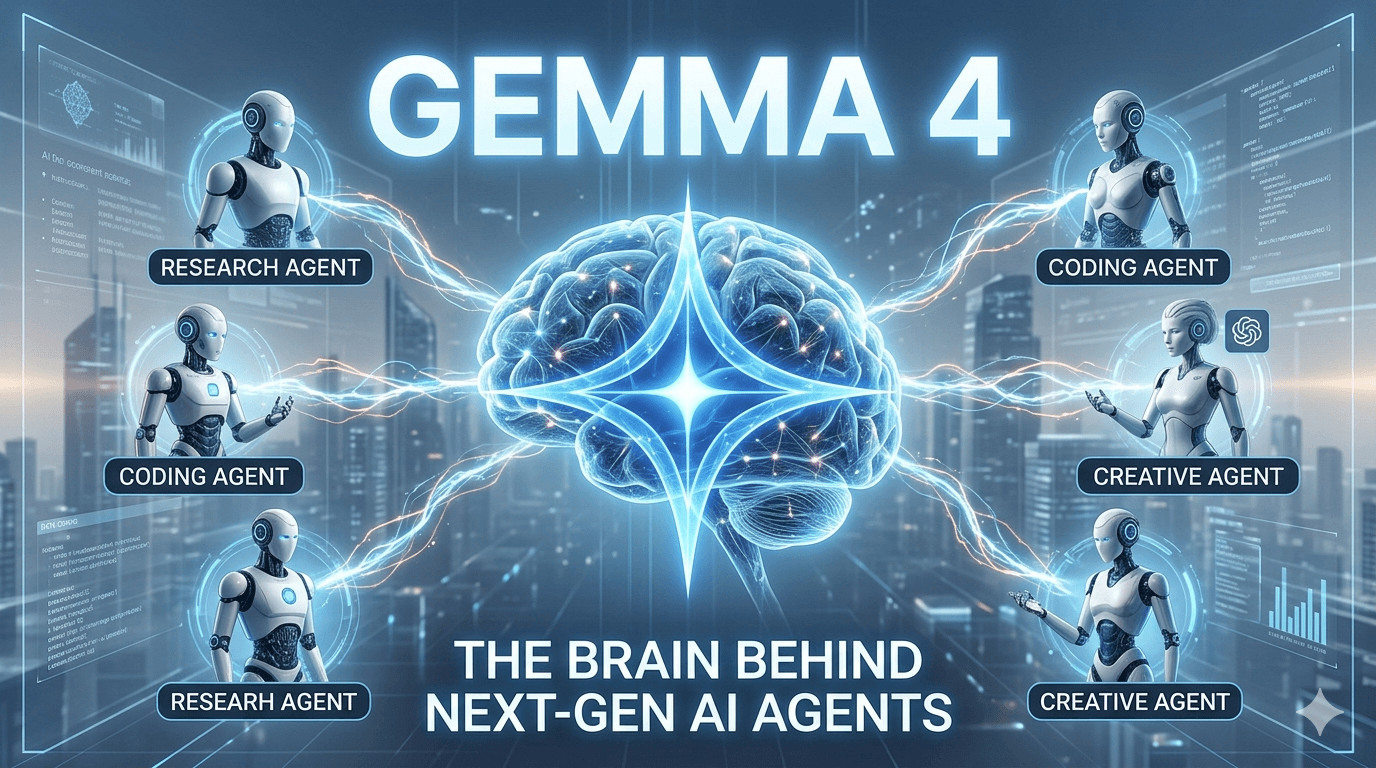
Everyone is building AI agents. But most are building them backwards. Almost no one talks about what actually makes them work. Not the orchestration layer. Not the memory architecture. Not the tool registry or the workflow graph. Those are just the skeleton. What actually determines success is the model at its core: “the brain.”
The system that decides what to do next, which tool to call, when to stop, and how to recover when something breaks. For the last two years, building reliable AI agents on open models meant accepting hard limits. You could engineer around the gaps with longer prompts, fallback logic, and aggressive output validation, but the limit was always there. Because the model was never built for it.
Gemma 4 is the first open model family purpose-built for agentic AI. Not retrofitted. Not scaffolded into capability. Built from the ground up with native reasoning, native tool use, native multimodal perception, and native context control to be the brain an agent actually needs.
What Agents Actually Need From a Model
Most AI teams learn this the hard way: They take a capable base model, write a detailed system prompt, add tool definitions, and assume the agent will behave reliably. For simple tasks, it does. Then the workflow gets longer. The tool outputs get messier. The task requires three steps of reasoning before the right action becomes obvious.
Then the agent breaks. It calls the wrong tool. It hallucinates API arguments. It loops when it should stop. Or it answers with confidence when the correct behavior was to ask a clarifying question.
This is not a prompt engineering failure. It’s a model architecture failure.
Because an AI agent does not need a model that generates good text. It needs a model that can do four specific things reliably:
- Plan across multiple steps by breaking a goal into a sequence of actions without losing track of the objective.
- Call tools with precision by producing structured and correct function calls with the right parameters instead of rough guesses.
- Observe and adapt by receiving tool outputs, interpreting them in context, and deciding what to do next without losing track of prior state.
- Know when to stop by recognizing task completion and ending cleanly without unnecessary looping or stopping too early.
The Native Agentic Architecture
The design choices inside Gemma 4 are not incidental. They are the result of a deliberate engineering philosophy: agents are the use case, not an afterthought.
Native Function Calling. Gemma 4 ships with structured tool-use support built directly into the model not layered on through prompt templates. This means function calls are generated with correct syntax, correct argument types, and correct field population. The gap between what the model outputs and what the tool executor can run is dramatically narrower than with any prior open model.
Structured JSON output is reliable and schema aligned by default. For agent workflows that depend on state, routing, and decisions, this is not optional, it is foundational. Native system prompt support gives precise control over behavior, constraints, and tool access. This is the level of control required for enterprise grade agents.
Configurable Reasoning Modes. All four Gemma 4 models include a built-in thinking mode multi-step chain-of-thought reasoning that the model performs before committing to an action. For complex agentic tasks, this is the difference between an agent that reacts and an agent that plans. Toggle it on when the task demands it. Turn it off when latency matters more than deliberation.
"Prompting tells the model what to do. Architecture determines what the model is capable of doing. Gemma 4 changes what open models are capable of.”
Perception: The Agent That Can See, Hear, and Read
The most capable agents of the next generation will not just read text. They will perceive the world of documents, screens, voices, images, video and act on what they observe.
Gemma 4 is built for this.
- Vision is native across every model size. It can analyze scanned contracts, extract data from charts, interpret UI screenshots, identify objects in images, and read handwritten notes within the same reasoning loop. For browser automation and screen parsing, it can also locate and point to elements, not just describe them.
- Audio is processed directly on device in supported models, handling short speech inputs without external calls. This enables private, low latency voice interactions where the agent can listen, transcribe, reason, and respond in one flow.
- Video understanding allows the model to process sequences of frames over time. For monitoring, logistics, or field inspection, this means the agent can observe situations as they unfold rather than rely only on text descriptions.
- Document and multimodal reasoning are built in. This includes OCR across languages, PDF parsing, chart understanding, and screen interpretation. It reflects how real data appears in practice, as visual and unstructured inputs rather than clean text.
Context: The Agent That Doesn't Lose the Thread
One of the most common failure modes in agentic AI is context collapse. The agent starts strong, but as the workflow grows and context fills with intermediate steps, it loses coherence, contradicts itself, and drifts from the original goal. This is not just about memory size. It is about how context is handled.
Gemma 4 addresses this at the architecture level, with context windows up to 256k tokens on larger models and 128k on edge models. A hybrid attention design balances local focus with global awareness, while Dual RoPE preserves positional accuracy as context grows. This allows the model to maintain consistency across long, multi step workflows without losing track of earlier decisions. For agents, this is critical. If the model loses the thread, the system stops being reliable.
Right-Sized Intelligence for Every Deployment
One of the smartest design decisions in Gemma 4 is the model spectrum. Not a single model for every use case, but four models, each built for a specific deployment context.
E2B (Effective 2B) is designed for on device, mobile, and IoT environments. It runs under 1.5GB RAM with 4 bit quantization, supports native audio input, and handles 128K context. This is an agent that fits in your pocket, runs offline, and still delivers meaningful capability.
E4B (Effective 4B) targets edge and laptop deployment. With native audio and 128K context, it offers a practical balance for enterprises that want local agents without heavy infrastructure.
The 26B MoE model is built for workstations and cloud. It uses only 4B active parameters during inference, supports 256K context, and delivers strong performance efficiency. This makes it well suited for orchestration, middleware, and multi agent coordination.
The 31B dense model is designed for complex, high stakes reasoning. With 256K context and significantly stronger benchmark performance than earlier generations, it is built for tasks that demand deep, multi step decision making.
The E2B and E4B models also introduce Per Layer Embeddings, injecting signals at every decoder layer. This is why smaller models perform far beyond their apparent size. Intelligence here is driven by design, not just scale.
Enterprise Agent Use Cases
Autonomous Document Intelligence Agents. A 26B MoE agent with a 256K context window can process entire contract sets, regulatory filings, or audit trails in one pass. With native function calling, it goes beyond reading to extracting, flagging, and triggering downstream workflows without human intervention for routine tasks.
Voice First Operational Agents. E4B running on a field device can receive spoken instructions, process them on device, reason over logs and records, and return structured actions in real time without cloud dependency. The agent operates where the work happens. Screen Aware Automation Agents. With visual understanding and UI element detection, agents can navigate interfaces, fill forms, and execute workflows across systems that were never built for APIs.
Multimodal Research and Synthesis Agents. By combining document reading, chart interpretation, image analysis, and video reasoning in one context, these agents can handle complex research and synthesis tasks across domains. Multilingual Customer Facing Agents. With broad language support out of the box, a single deployment can serve global users without separate models or localization layers.
Final Thoughts
The first generation of AI agents was built despite the models, not because of them. Engineers wrote clever prompts to simulate planning. They added validation layers to catch hallucinated tool calls. They built retry logic to compensate for models that couldn't recover from errors. They shipped agents that worked mostly and called it production.
That phase is coming to a close. Models like Gemma 4 shift the center of gravity from workaround engineering to capability driven design. When reasoning, tool use, perception, and context handling are built in, the focus moves to how systems are composed, not how models are constrained.
At M37Labs, we support these models and the ones that follow, building agent systems that are designed for where this technology is going, not where it started. Our view is clear: the teams that wire Gemma 4 into their agent architectures today will be the teams running autonomous, intelligent operations at scale while their competitors are still debugging prompt templates.