



The Hidden Optimization That Makes Large Language Models Feel Instant
KV Cache is a core optimization that speeds up LLMs by storing and reusing previously computed attention states instead of recalculating them. It reduces latency, GPU usage, and infrastructure costs, enabling scalable, real-time AI while newer attention architectures further improve memory efficiency.
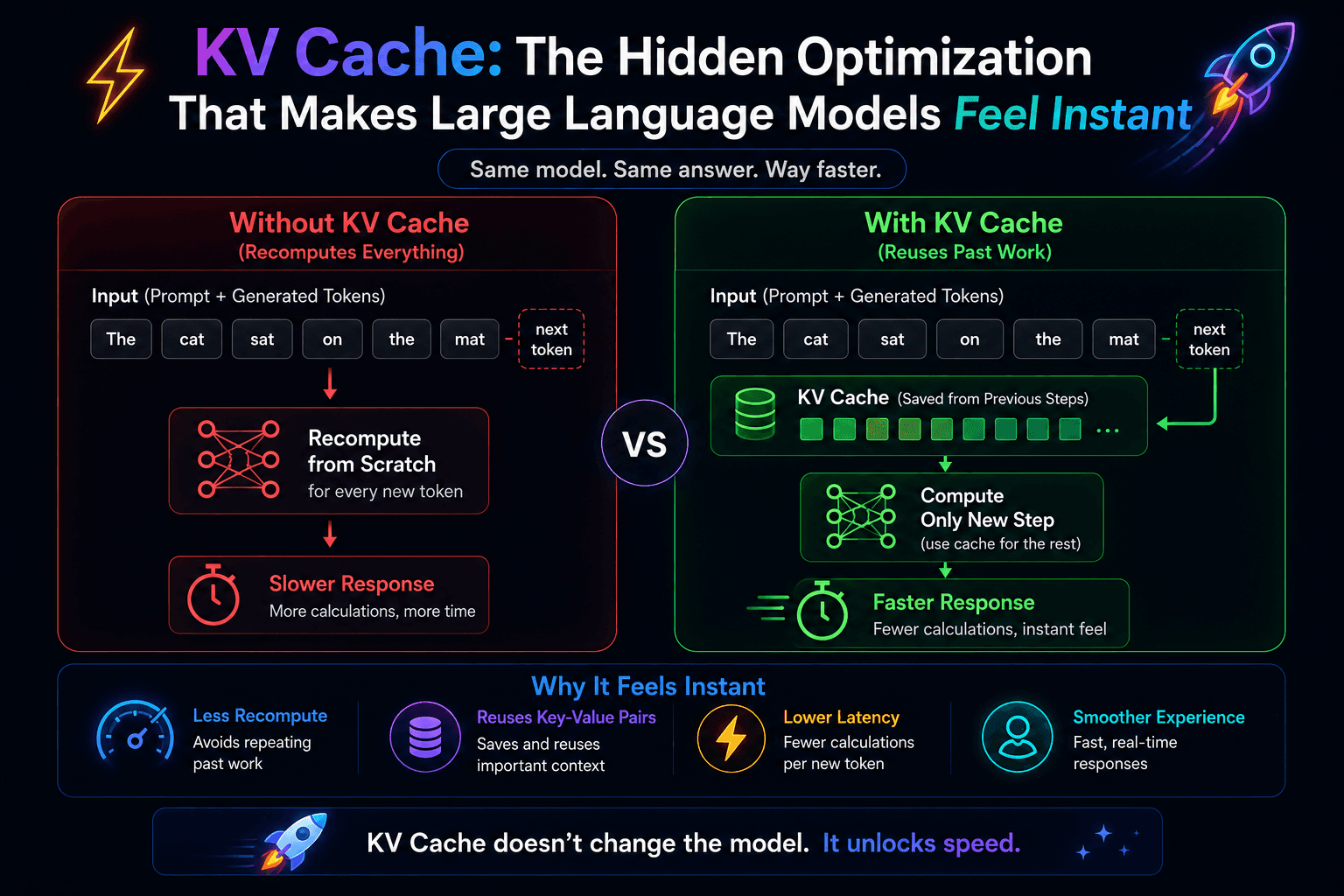
Why every enterprise building AI applications should understand the technology that silently reduces latency, cuts compute costs, and makes conversational AI practical at scale.
When people talk about Large Language Models (LLMs), the conversation usually revolves around bigger models, longer context windows, reasoning capabilities, or multimodal intelligence.
But one of the most important breakthroughs powering today's AI systems is something most users and even many developers never notice. It's called Key-Value (KV) Cache.
Without KV caching, conversational AI as we know it would feel dramatically different. Responses would be slower, infrastructure costs would soar, and serving millions of users simultaneously would become significantly more difficult.
Whether you're using ChatGPT, Claude, Gemini, or an enterprise AI assistant, KV Cache is one of the core engineering optimizations that makes real-time conversations possible.
For organizations deploying LLMs into production, understanding KV Cache isn't just a systems engineering topic anymore; it's a business optimization strategy. Lower latency improves customer experience. Reduced GPU computation lowers infrastructure costs. Faster inference increases throughput, enabling more users to be served with the same hardware.
In many ways, KV Cache is the hidden memory optimization that transforms transformer models from impressive research prototypes into production ready AI systems.
Why Text Generation Is So Computationally Expensive
Unlike traditional machine learning models that generate an entire output in one pass, autoregressive language models produce text one token at a time.
Imagine the prompt:
"Artificial Intelligence is transforming..."
The model generates something like this:
- Artificial
- Artificial Intelligence
- Artificial Intelligence is
- Artificial Intelligence is transforming
- Artificial Intelligence is transforming enterprises
- Artificial Intelligence is transforming enterprises by...
Every newly generated token becomes part of the input for predicting the next one. That seemingly simple process creates a significant computational challenge. For every new token, the model must understand its relationship with every token that came before it.
Without any optimization, the transformer repeatedly performs nearly identical computations over the entire conversation history again and again for every new token it generates. Imagine rewriting an entire book every time you add a single new sentence. That's essentially what happens without KV Cache.
A Quick Refresher: How Self-Attention Works
At the heart of transformer models lies Self-Attention, the mechanism that allows every word to understand the context provided by every other word.
For every input token, the model creates three vectors:
- Query (Q): What information is this token looking for?
- Key (K): What information does each previous token contain?
- Value (V): What information should ultimately be passed forward?
Think of attention as an intelligent search engine. The current token creates a Query. Every previous token contributes a Key and a Value.
The Query is compared with all Keys to determine which previous tokens are most relevant. Those relevance scores are then used to combine the corresponding Values into a richer representation of the current token.
Conceptually, the process looks like this:
Current Token → Query → Compare with Previous Keys → Attention Scores → Weighted Values → Updated Representation
This happens not once, but across every layer of the transformer. For modern LLMs with dozens or even hundreds of layers, attention quickly becomes one of the most computationally expensive parts of inference.
The Brilliant Optimization: Stop Recomputing What You Already Know
Instead of recalculating Keys and Values for every previous token during every generation step, why not simply...
store them?
That's exactly what KV Cache does. KV Cache follows a simple but highly effective principle:
Compute Keys and Values once. Store them. Reuse them for every future token.
Instead of recalculating previous attention states repeatedly, the model stores the computed Key and Value tensors in memory.
When a new token arrives:
- Generate Key and Value only for the new token.
- Append them to the cache.
- Reuse all previously stored Keys and Values.
- Perform attention using the cached representations.
The expensive computations for earlier tokens never need to be repeated. Only incremental work is performed. This dramatically accelerates autoregressive generation.
Why the First Token Always Feels Slower
Have you ever noticed that AI assistants often pause briefly before streaming text almost instantly? KV Cache explains exactly why. The first phase of inference is called the Prefill Phase.
During this stage:
- Every token in the prompt is processed.
- Keys and Values are computed across every transformer layer.
- The entire KV Cache is built from scratch.
Only after this cache exists can the model begin generating responses. Once generation starts, inference enters the Decoding Phase. Now, instead of processing the entire prompt repeatedly, the model only processes one new token at a time, while reusing everything already stored in the cache. That's why the first token usually takes the longest to appear, while the remaining response streams rapidly.
Why KV Cache Matters for Enterprise AI
Enterprise AI systems rarely generate just a few words.
Consider applications like:
- Customer support assistants
- Financial analysis copilots
- Legal document drafting
- Enterprise knowledge search
- Software engineering copilots
These systems often generate hundreds or even thousands of tokens during a single interaction.
Without KV Cache:
- Every generated token requires repeated attention computations.
- GPU utilization increases dramatically.
- Response latency grows.
- Infrastructure costs rise.
- Scalability becomes challenging.
With KV Cache:
- Responses become significantly faster.
- GPU workloads decrease.
- More concurrent users can be served.
- Cloud inference costs are reduced.
- Overall user experience improves.
For organizations running LLMs at scale, these gains translate directly into lower operational costs and better business outcomes.
The Next Frontier: Smarter Inference
The AI industry often celebrates larger parameter counts, longer context windows, and increasingly capable reasoning models. But production success isn't determined by model size alone.
It depends on how efficiently those models run. As context windows expand from thousands to hundreds of thousands and eventually millions of tokens, KV Cache itself becomes a new engineering challenge.
The larger the context, the larger the cache. Managing that memory efficiently is now one of the biggest areas of innovation in modern LLM inference.
This is why newer architectures are emerging, including:
- Multi-Query Attention (MQA) – Multiple attention heads share a single Key and Value, dramatically reducing cache size.
- Grouped Query Attention (GQA) – A balance between standard multi-head attention and MQA, offering lower memory usage with minimal quality loss.
- Multi-Head Latent Attention (MLA) – Compresses attention representations into compact latent spaces, enabling faster inference with significantly smaller memory footprints.
These innovations aren't replacing KV Cache; they're making it more memory-efficient, allowing larger models to serve more users on the same hardware.
Final Thoughts
The future of AI won't be defined solely by building bigger models. It will be defined by building smarter inference systems around them.
KV Cache is one of the simplest yet most transformative optimizations in modern deep learning. It quietly eliminates redundant computation, accelerates response generation, reduces infrastructure costs, and makes large-scale conversational AI economically practical.
Most users will never know it exists. Yet every smooth, real-time conversation with an LLM depends on it. Sometimes, the fastest AI isn't the one doing more work; it's the one intelligent enough not to do the same work twice.