



The Most Important AI Feature Isn't Intelligence
AI’s next breakthrough is memory, not raw intelligence. Future enterprise systems must retain context, learn from experience, connect historical knowledge, and act continuously over time. As intelligence becomes commoditized, memory will emerge as the defining differentiator.
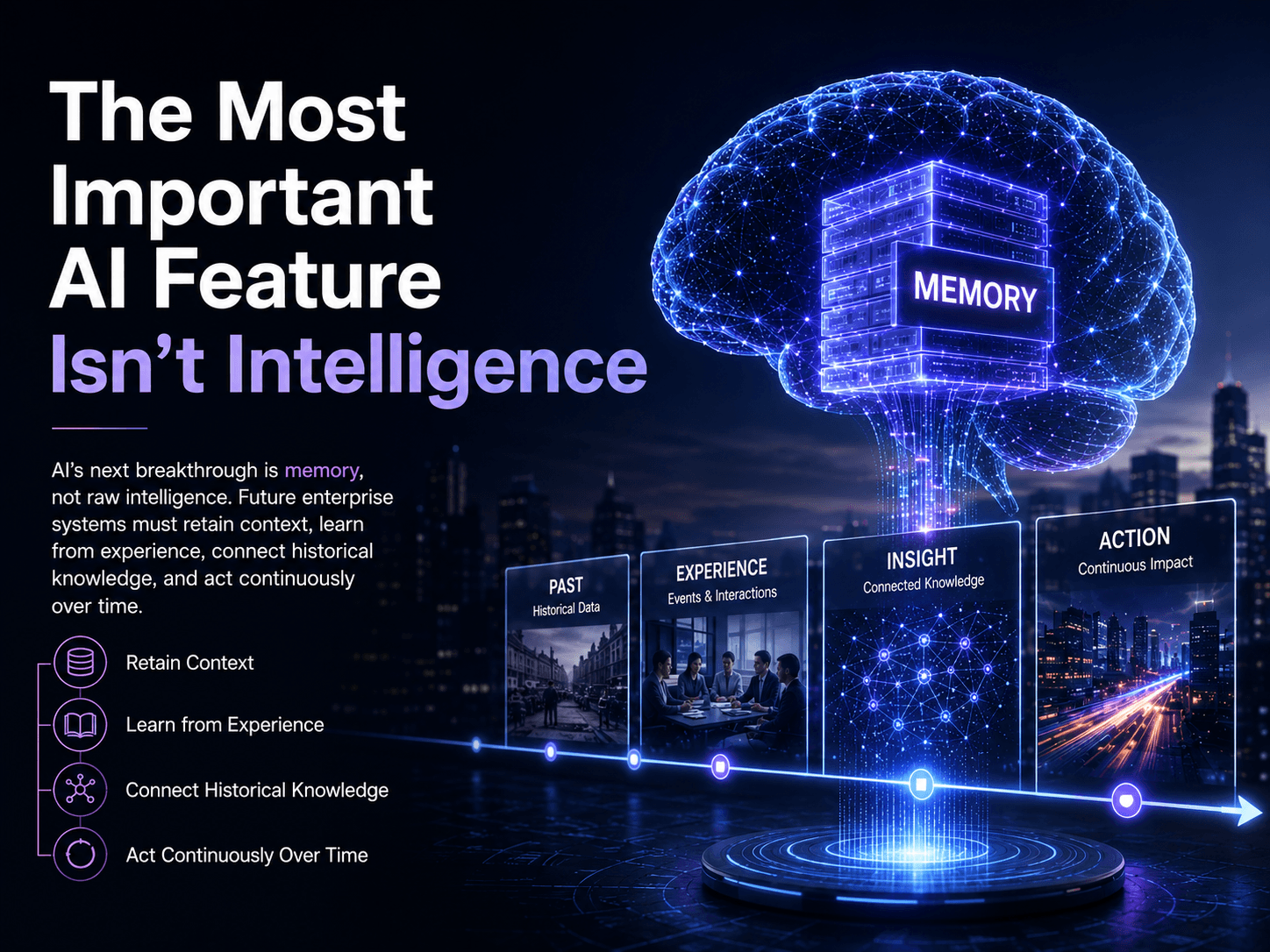
Why AI Memory Will Define the Next Era of Artificial Intelligence
Every day, humanity generates more than 400 million terabytes of data. Emails, documents, conversations, transactions, videos, support tickets, code repositories, meeting notes, and business records continue to grow at an unprecedented pace.
Yet despite having access to more information than ever before, most AI systems still suffer from the same fundamental limitation:
They forget.
And that's exactly why memory, not intelligence, has become the defining challenge of the next AI era.
AI Is Getting Smarter. Humans Are Still Different.
Almost every week, a new state-of-the-art model is released.
Models are becoming faster. Multi-step reasoning capabilities are improving. Agentic systems are displaying higher degrees of autonomy. Context windows are stretching to millions of tokens. Academic and industry benchmarks continue to be broken. The AI industry is advancing at a breathtaking pace.
But despite all of these remarkable advancements, there is one critical area where machines still fundamentally lag behind humans: Memory.
Humans are not intelligent merely because we can solve isolated problems. We are intelligent because we remember. We accumulate experiences over a lifetime. We connect disparate nodes of knowledge across years. We learn from our mistakes, and we build rich contextual frameworks over time.
A child does not become an expert overnight. Human intelligence develops and matures because our memories accumulate and our knowledge compounds.
Intelligence Without Memory Has Limited Value
Think about the people every organization depends on.
A senior engineer is valuable not simply because they are intelligent. They are valuable because they remember years of architecture decisions, business constraints, customer challenges, technical debt, production failures, and project outcomes.
A doctor’s expertise is built upon thousands of patient interactions, diagnoses, symptoms, treatments, and accumulated experiences.
Their intelligence becomes valuable because it is built on a foundation of deep, structured memory. Remove that memory, and much of their professional effectiveness instantly disappears.
The same exact principle applies to artificial intelligence. A model can generate exceptional, isolated responses. It can write flawless code blocks, analyze massive documents in a single prompt, and answer complex questions. But if it forgets absolutely everything the moment the user session ends or the chat window is closed, its long-term use is fundamentally bottlenecked.
The immediate challenge is no longer finding an intelligent model. The challenge is building an AI system that remembers, learns, and adapts over time.
In real-world business environments, operational success depends on continuity. An enterprise AI assistant should not simply answer a question as if it is meeting you for the first time. It must understand:
- What happened yesterday in the engineering sync.
- What strategic decisions were made last week regarding product direction.
- What action items were assigned during the cross-functional meeting.
- Which critical customer issues remain unresolved.
- What broader business objectives are currently active and prioritized.
Most AI systems today can think. Very few can truly remember.
Memory Will Power the Next Generation of Intelligence
The next generation of AI will not be judged by how impressive a demo looks.
It will be judged by whether the system can operate like a capable team member.
Imagine an AI that attends a meeting. Instead of simply generating a passive transcript or a generic summary of the discussion, it actively:
- Identifies immediate action items.
- Assigns clear ownership to team members based on past roles.
- Tracks historical deadlines and monitors ongoing progress.
- Remember previous discussions from months ago to prevent duplicate work.
- Connects decisions across entirely different departments.
- Follows up automatically when deliverables are due.
That is how high-performing humans operate. We do not just process passing information; we retain it, connect it to past events, and act on it over time. AI systems must transition to this exact operational model.
Without memory, AI remains reactive. With memory, AI becomes truly operational.
The World's Largest Asset Is Data
Enterprises already possess the raw material needed to fuel these intelligent, memory-capable systems: Data. And as established, the volume of this data grows every second through:
- Customer support conversations
- Internal documentation
- Historic project files and slack channels
- Recordings of client meetings
- Core operational workflows and database histories
The primary challenge is no longer collecting information. The challenge is making sense of it.
Most enterprise knowledge currently remains fragmented across dozens of disconnected systems, apps, and departments. As a result, invaluable historical context is constantly lost, duplicated, or forgotten. The enterprises that succeed in the AI era will be those that can successfully transform this chaotic, growing mountain of data into a single, cohesive, and usable memory layer.
Memory Comes at a Cost
Building memory-driven AI systems is not an easy technical feat.
Raw intelligence can be easily rented through a third-party API. Memory, however, cannot. To build true memory, organizations must actively invest in:
- Robust Data Infrastructure: Scaling pipelines to ingest data in real-time.
- Dynamic Storage Systems: Choosing the right database paradigms to store semantic context.
- Knowledge Architectures: Modeling how concepts, projects, and entities relate to one another.
- Advanced Retrieval Mechanisms: Fetching the right memory at the right sub-second interval.
- Strict Governance & Security Frameworks: Ensuring privacy, access control, and compliance.
- Long-term Contextual Understanding: Distinguishing transient data from permanent organizational knowledge.
The more an AI system remembers, the greater the computational and operational cost of managing, updating, and securing that knowledge. This is currently one of the single biggest engineering hurdles facing the AI industry. Memory is not just an algorithmic problem; it is an infrastructure problem.
More Data Doesn't Automatically Mean Better Intelligence
A common misconception is that simply dumping more data into an LLM automatically makes it smarter.
It does not. The ultimate goal is not to store every single character of history; the goal is to understand what matters.
A truly intelligent memory system must learn from data without becoming overwhelmed by the noise. It must dynamically:
- Identify meaningful long-term patterns over minor anomalies.
- Understand complex, evolving relationships between projects and people.
- Retain highly relevant context while discarding redundant details.
- Avoid overfitting or drawing incorrect conclusions from outdated files.
- Minimize false assumptions and reduce confusion caused by conflicting information.
Humans do this naturally. We do not remember every single word spoken to us in a meeting three years ago. Instead, we remember the core decisions made, the emotional resonance of the agreement, and we apply that distilled context when it is needed.
The future of AI memory must follow this exact same selective paradigm. The challenge is not remembering everything—the challenge is remembering the right things.
Why This Matters Right Now
The AI industry is rapidly approaching a point where model intelligence alone is no longer a sustainable differentiator. Most leading foundation models can already write code, run advanced analysis, and brainstorm strategies at roughly equivalent levels.
The next big competitive advantage is not who has access to the smartest model. It is who builds the most effective, customized memory layer.
Because intelligence without memory resets to zero every single day.
Memory, on the other hand, compounds. And compounded organizational knowledge becomes a highly defensible, unique competitive advantage that competitors cannot easily duplicate, buy, or replicate.
How We See the Future at M37Labs
At M37Labs, we believe the future of AI is not about building systems that simply generate static answers. It is about building systems that behave like humans.
- Humans learn.
- Humans remember.
- Humans connect experiences.
- Humans act on accumulated knowledge.
The next generation of enterprise AI must do the exact same.
This is why we are entirely focused on building memory-intelligent systems, systems that do not just process information passively, but understand deep historical context, retain mission-critical knowledge, track commitments, and continuously evolve through real-world experience.
The first generation of AI learned from the static internet. The next generation of AI will learn from dynamic experience. And just like humans, the systems that remember the most will ultimately become the most valuable.
The future belongs to the AI that remembers. Because the most powerful AI system isn't the one that can answer the most questions; it is the one that never forgets what matters.