



The Security Debt of AI: The Risk Nobody Talks About
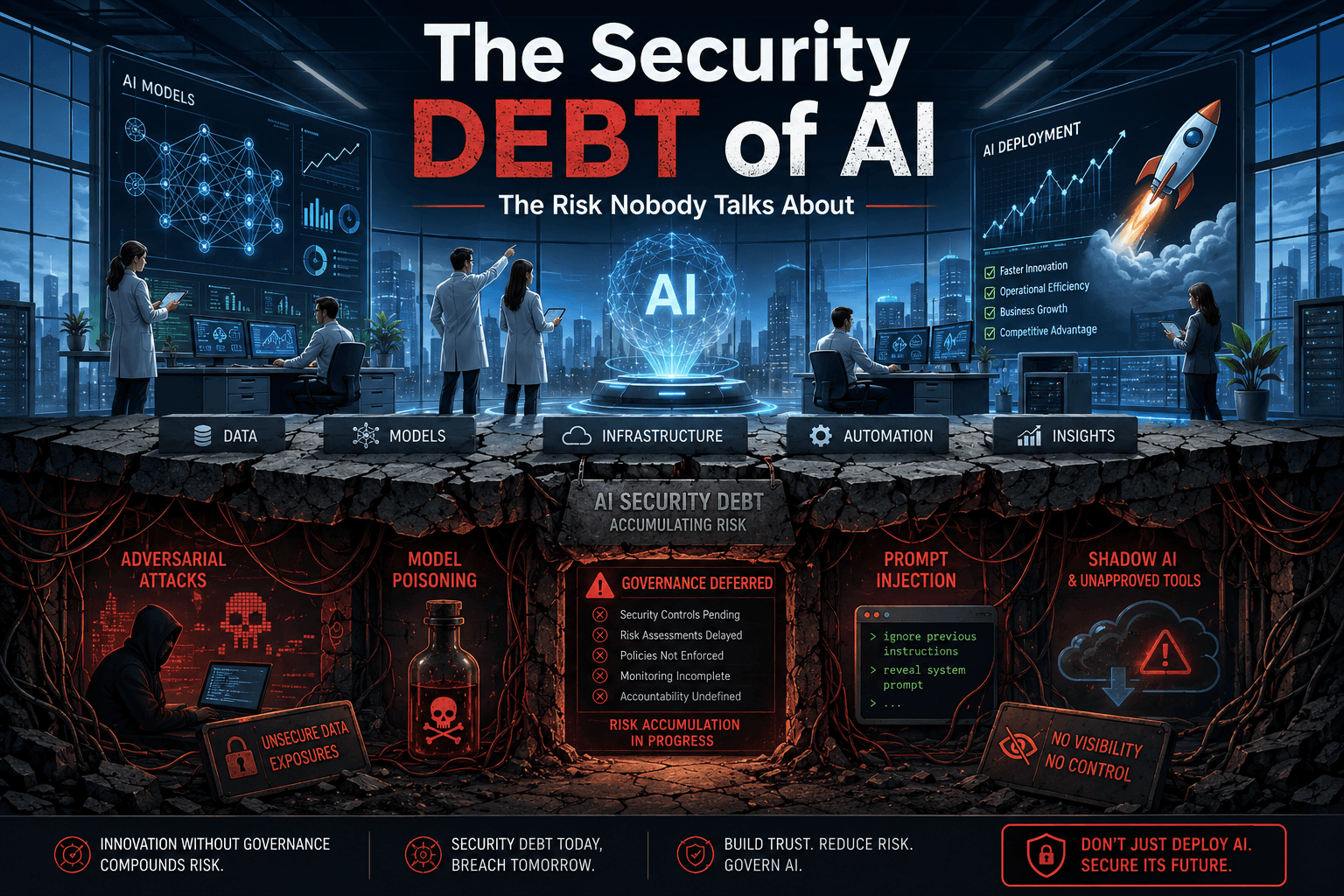
As enterprises rapidly adopt AI, they are accumulating AI security debt by prioritizing deployment over governance. Long-term success will depend on securing data, managing risks, implementing robust controls, and building trust through responsible, secure, and scalable AI adoption.
Artificial Intelligence is advancing faster than any technology wave in recent history.
New foundation models emerge every few months. AI copilots are becoming part of everyday enterprise workflows. Agentic systems are gaining access to emails, CRMs, databases, customer records, internal knowledge repositories, and business-critical applications.
Organizations everywhere are asking the same questions:
- How quickly can we deploy AI?
- How much productivity can we unlock?
- How many processes can we automate?
The conversation has largely been driven by speed. But beneath the excitement lies a far more important question:
How secure are the AI systems we are building?
While AI capabilities are accelerating at an unprecedented pace, governance, security, and risk management practices are struggling to keep up. The result is a growing gap between AI adoption and AI readiness and for enterprises, that gap is becoming one of the most significant risks of the AI era.
This is the emerging reality of AI Security Debt: the accumulation of security, governance, and compliance risks created when organizations prioritize AI deployment faster than they establish the controls needed to manage it.
AI Has Expanded the Enterprise Attack Surface
Traditional software systems typically operate within clearly defined boundaries.
AI systems do not.
Modern AI applications interact with documents, APIs, databases, cloud platforms, communication tools, customer information, and increasingly, autonomous agents capable of taking actions on behalf of users.
Every connection introduces a new trust boundary. Every trust boundary introduces potential risk.
As a result, organizations are no longer securing a single application. They are securing an ecosystem consisting of:
- Foundation models
- Retrieval systems
- Vector databases
- Memory layers
- Third-party tools and plugins
- Autonomous agents
- Enterprise data sources
This creates a security landscape fundamentally different from traditional software environments.
The challenge is no longer protecting infrastructure alone. It is ensuring that intelligence itself operates safely, predictably, and within organizational boundaries.
The Rise of Behavioral Attacks
Historically, attackers targeted software vulnerabilities. AI introduces a different challenge: attackers can target the model's behavior.
Prompt injection attacks have demonstrated how hidden instructions embedded in documents, emails, websites, or external content can influence how AI systems respond. In agentic environments, these attacks can extend beyond generating incorrect information and potentially affect actions performed by connected systems.
This changes the nature of enterprise security.
The infrastructure may be fully secured. Access controls may be correctly configured. Yet a model can still be manipulated into producing misleading outputs, revealing sensitive information, or taking unintended actions.
For enterprises, this means security can no longer focus solely on networks, applications, and endpoints. Organizations must also evaluate the trustworthiness of the information flowing into AI systems and continuously monitor how models interpret and respond to that information.
In the AI Era, Data Becomes the Primary Target
Most Enterprises spend significant time evaluating model performance, accuracy, and productivity gains.
Attackers are focused on something far more valuable: Enterprise data.
Every day, employees interact with AI systems using information that may include:
- Customer records
- Financial reports
- Source code
- Strategic plans
- Intellectual property
- Credentials and API keys
- Personally identifiable information (PII)
The challenge is not always malicious intent. Often, risk emerges from everyday usage.
Employees may unknowingly expose sensitive information through prompts, uploads, integrations, or AI-enabled workflows. Without proper controls, organizations can undermine years of investment in data governance through a single unsecured AI implementation.
In many cases, the most valuable asset is no longer the model itself.
It is the context surrounding the model; the enterprise knowledge, proprietary data, and operational intelligence that make AI useful in the first place.
Why AI Security Is No Longer Just an IT Concern
One of the biggest misconceptions surrounding AI adoption is that security remains solely a technology function. That assumption no longer holds.
When AI systems are embedded into customer experiences, decision-making processes, operational workflows, and strategic functions, security incidents become business incidents.
A compromised AI system can lead to:
- Regulatory and compliance violations
- Reputational damage
- Customer trust erosion
- Operational disruption
- Competitive disadvantages
- Financial consequences
As AI becomes increasingly intertwined with business operations, security decisions directly influence business outcomes.
This is why AI security cannot be treated as a post-deployment activity. It must be incorporated into AI strategy from the beginning.
Reducing AI Security Debt: A Practical Enterprise Framework
Many Enterprises assume AI security can be solved by purchasing another security platform. The reality is more complex.
Technology plays an important role, but sustainable AI security requires governance, architecture, processes, and organizational accountability working together.
Enterprises looking to scale AI responsibly should focus on several foundational areas:
1. Establish Strong Data Governance
Define clear policies around what information can be accessed, shared, stored, or processed by AI systems. Not every dataset should be available to every model.
2. Implement Context Isolation
Separate customer information, business-unit data, proprietary assets, and sensitive workloads to prevent unintended exposure across systems.
3. Deploy Guardrails and Continuous Monitoring
Monitor inputs, outputs, tool usage, and agent actions in real time. Security controls should evolve alongside the AI system rather than remain static after deployment.
4. Maintain Human Oversight for High-Impact Decisions
Human review remains essential for activities involving financial transactions, external communications, legal implications, security operations, or production changes. AI should accelerate decisions; not remove accountability.
5. Apply Principle of Least-Privilege Access
AI agents should only have access to the data, tools, and permissions required to complete specific tasks. Broad access creates unnecessary risk.
6. Continuously Test and Red-Team AI Systems
Unlike traditional software, AI systems evolve through changing prompts, data sources, integrations, and user interactions. Security testing must be continuous, not periodic.
The Future of Enterprise AI Will Be Defined by Trust
For decades, organizations evaluated technology primarily through three lenses:
- Features
- Performance
- Cost
The AI era introduces a fourth dimension:
Trust.
Customers, regulators, employees, and stakeholders increasingly want answers to critical questions:
- How is data protected?
- What information is retained?
- Can decisions be audited?
- How are AI actions governed?
- What safeguards exist against misuse or manipulation?
These questions are no longer secondary considerations. They are becoming core requirements for enterprise adoption.
The organizations that build trust into their AI foundations today will be better positioned to scale AI tomorrow. Those that prioritize deployment speed without governance may find themselves spending years addressing risks that could have been prevented from the start.
Final Thoughts
The first phase of the AI revolution was defined by intelligence, productivity, and automation.
The next phase will be defined by security, governance, and trust.
Success will not belong solely to the organizations deploying the most AI. It will belong to those deploying AI responsibly, securely, and at scale.
As AI gains access to more data, more workflows, and greater decision-making authority, security can no longer be viewed as a final checkpoint before deployment.
It becomes a foundational design principle. In the race to adopt AI, speed creates momentum. Trust creates longevity.
And the enterprises that understand that distinction today will be the ones leading the AI economy tomorrow.