



Why Data Centers Are the New Oil Fields
AI has shifted from a software race to an infrastructure race. Compute, powered by data centers, is becoming the key strategic resource of the AI economy. Success will depend on securing scalable infrastructure, improving efficiency, and achieving national and corporate AI sovereignty.
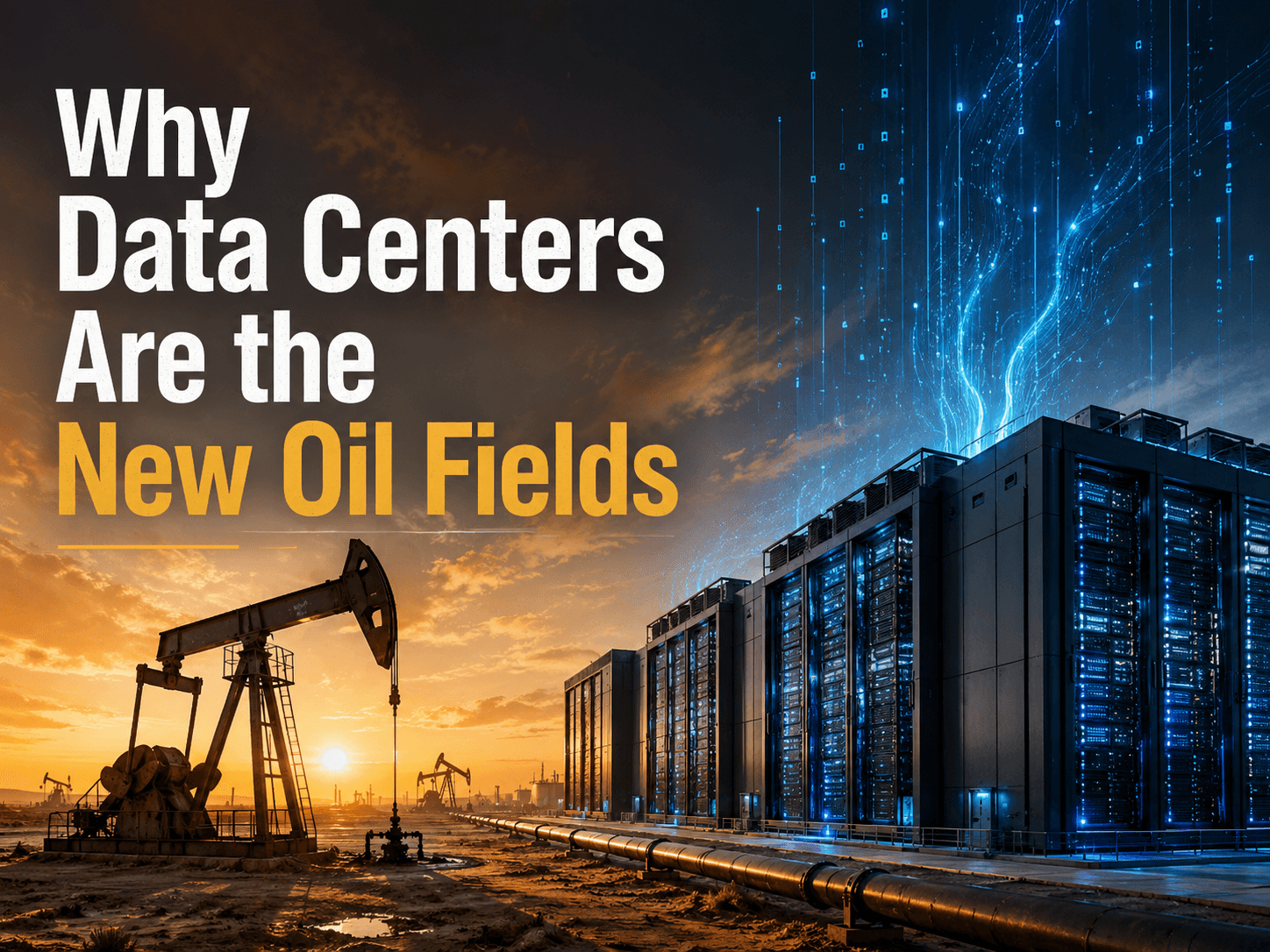
What if the most valuable resource of the 21st century isn't oil, gold, or even data? It's compute.
And the factories producing it aren't oil rigs or refineries. They're data centers.
For more than a century, oil shaped the global economy. Nations that controlled oil reserves influenced trade, powered industrial growth, and gained significant geopolitical leverage. Access to energy became synonymous with economic strength.
AI isn't becoming an infrastructure business. It already is. Just as oil powered the industrial economy, compute is powering the intelligence economy.
Data centers have become the foundational infrastructure of the AI era, powering artificial intelligence, digital economies, and the next generation of innovation.
And the race for AI leadership is no longer just about building smarter models. It's about securing the infrastructure required to train, deploy, and scale them.
From Software Competition to Infrastructure Competition
For years, AI competition centered around algorithms, datasets, and model architectures. Companies gained advantages through:
- Better machine learning models
- Larger datasets
- More sophisticated software capabilities
- Superior user experiences
Those factors still matter. But the competitive landscape is evolving.
Modern AI systems require enormous computational resources. Training frontier models demands massive GPU clusters operating continuously for weeks or even months. Serving millions of AI-powered requests every day requires equally significant infrastructure.
As a result, the bottleneck is no longer intelligence alone. It's compute.
Competitive advantage is shifting from software ownership to infrastructure access and operational efficiency. Organizations that can secure, optimize, and scale compute resources will increasingly dominate the AI economy.
Why Software Companies Should Care
Many software and SaaS companies still view infrastructure as something that cloud providers simply handle in the background.
That assumption may become increasingly dangerous. As AI becomes embedded in products, workflows, and business operations, infrastructure directly impacts:
- Product performance
- Response times
- Scalability
- Operating costs
- Profitability
A company may build an exceptional AI product, but without reliable and cost-effective compute resources, growth can quickly hit a ceiling.
Infrastructure is no longer just a technical consideration. It is becoming a competitive advantage in its own right.
The Next AI Challenge: Running AI Efficiently
The first wave of AI was about building models. The next wave is about operating them sustainably and profitably.
Organizations are increasingly asking questions such as:
- How can we reduce inference costs?
- Which infrastructure providers offer the best AI performance?
- Should we use proprietary or open-source models?
- How can we improve GPU utilization?
- How do we control rising compute expenses?
These are not merely software questions. They are infrastructure questions. As AI becomes a core part of business operations, infrastructure economics will become just as important as product innovation.
The Rise of the Compute Economy
In the industrial era, companies competed for access to raw materials and energy. In the AI era, they compete for access to compute.
Advanced AI chips, high-performance networking, reliable power, and large-scale data center capacity have become critical strategic assets.
NVIDIA's rise to become one of the world's most valuable companies was fueled largely by demand for AI infrastructure rather than traditional software.
Microsoft, Google, Amazon, and Meta are collectively investing hundreds of billions of dollars into AI-ready data centers, specialized chips, and energy infrastructure to support future AI workloads.
The demand for these resources is creating an entirely new economic landscape, one where access to compute increasingly determines who can innovate, scale, and compete. The companies and nations that secure these resources today are positioning themselves to lead the next wave of technological development tomorrow.
The Other Side of the Race: Efficiency
While the demand for compute continues to grow, another important trend is emerging.
Researchers and AI companies are finding ways to do more with less.
Advances in quantization, model compression, Mixture-of-Experts architectures, and smaller specialized models are significantly reducing the compute required to train and serve AI systems.
In other words, the future of AI won't be determined solely by who has the largest data centers. It will also be shaped by who can use compute most efficiently.
The winners of the AI era will likely excel at both:
- Scaling infrastructure
- Maximizing efficiency
AI Sovereignty: The New Digital Independence Movement
The infrastructure race extends far beyond businesses.
Governments increasingly recognize that dependence on external AI infrastructure creates strategic vulnerabilities, including:
- Technology dependence
- Data governance concerns
- Economic exposure
- National security risks
- Supply chain disruptions
As a result, many countries are investing heavily in domestic AI capabilities, data centers, semiconductor manufacturing, and sovereign cloud initiatives.
Just as nations once pursued energy security, they are now pursuing compute security.
The ability to train, deploy, and operate advanced AI systems within national borders is becoming a critical component of economic competitiveness and national resilience.
The New Oil Fields of the Digital Age
History rarely repeats itself exactly, but it often rhymes. In the twentieth century, oil fields powered economic growth, industrial expansion, and geopolitical influence. In the twenty-first century, data centers are beginning to play a similar role.
They power AI systems. They enable innovation.They attract investment. They drive economic competitiveness.
The global AI race is no longer defined solely by who builds the smartest models. It is increasingly defined by who can secure the compute, energy, networking, and infrastructure required to sustain them.
The next generation of technology leaders will not be determined by software alone. They will be defined by their ability to build, power, cool, and scale the infrastructure behind it.
Because in the age of artificial intelligence, data centers are no longer just buildings filled with servers.
They are the new oil fields. And the race to control them and power the next generation of intelligence has already begun.