



AI Observability: Metrics and Tooling for Production-Scale Models
AI observability offers a structured framework to monitor the behavior, accuracy, fairness, and cost efficiency of AI systems in real time. By extending traditional telemetry such as logs, metrics, traces into AI-specific metrics like drift, hallucinations, and bias, organizations gain visibility into model performance and integrity. This foundation is essential to ensure safe, ethical, and scalable AI deployments in production environments.
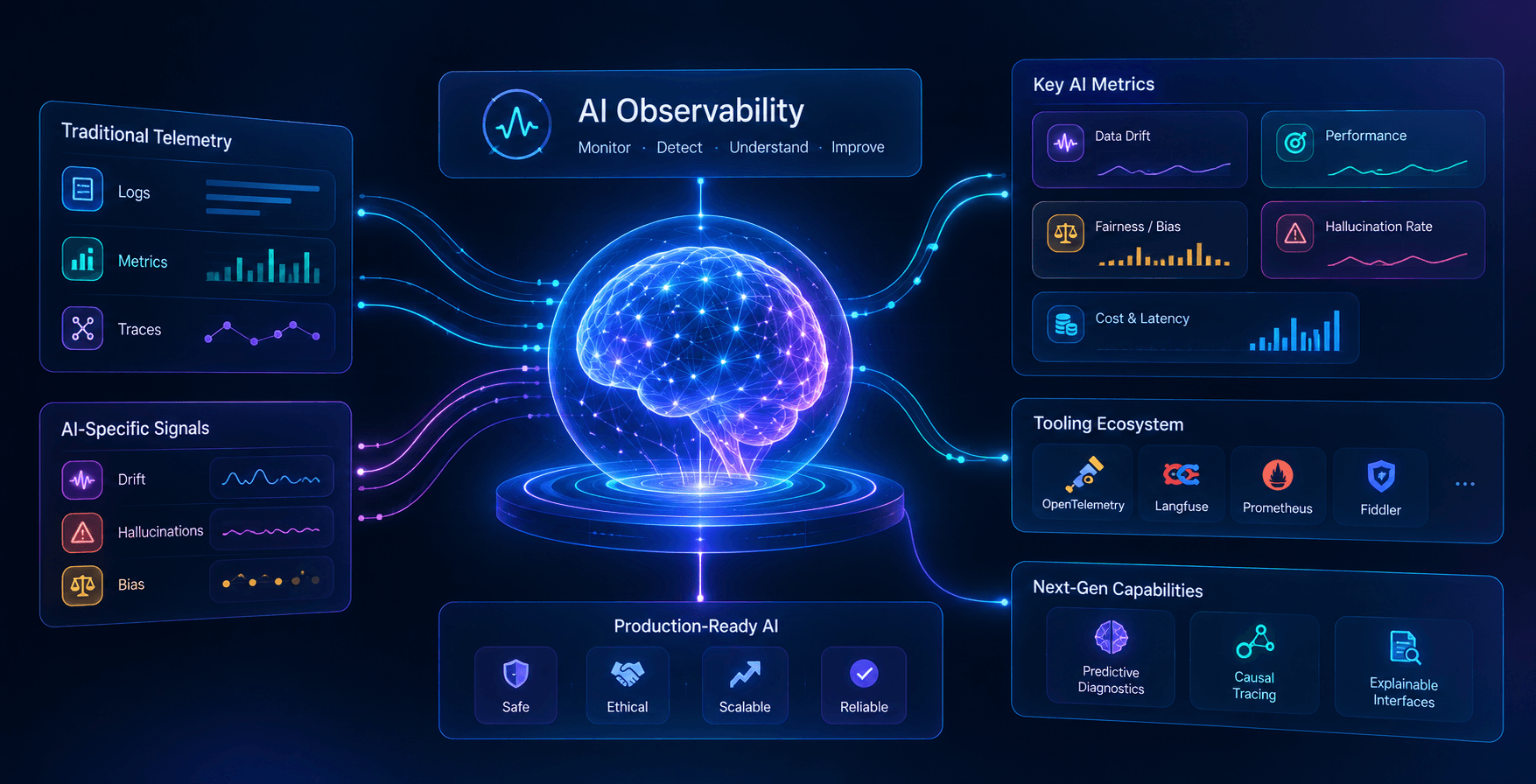
As AI systems move from lab prototypes to mission-critical infrastructure, observability becomes vital for sustained performance, fairness, and accountability. Unlike traditional monitoring, observability infers system health through correlated telemetry, revealing root causes behind failures or shifts. This paper maps the observability landscape for AI across five key domains: drift detection, performance metrics, bias evaluation, hallucination control, and cost-latency optimization. It also highlights best-in-class tools like OpenTelemetry and Langfuse while proposing next-gen capabilities such as predictive diagnostics, causal tracing, and explainable interfaces to build more transparent, auditable, and resilient AI systems at enterprise scale.
Key Highlights
- Telemetry Foundation Extended to AI: Combines logs, metrics, and traces with AI-native signals like drift, hallucination, and bias for deep system insight.
- Five Core Metric Categories: Covers data drift, performance accuracy, fairness bias, hallucination rate, and operational cost-latency metrics for end-to-end monitoring.
- Real-Time Model Integrity Checks: Enables dynamic alerting and retraining by integrating observability with CI/CD pipelines and inference workflows.
- Tooling Ecosystem Mapped: Evaluates modern observability tools such as Fiddler, Langfuse, Prometheus, OpenTelemetry for monitoring AI behavior and governance.
- Future Direction is Proactive Intelligence: Advocates for predictive observability systems with causal reasoning, enabling prevention of failures, not just detection.
Read Full Paper
Access the complete publication and technical insights.