



AI Cost Optimization Starts With Measuring Success, Not Usage
AI cost optimization is about more than reducing token costs. Measuring successful outcomes helps businesses identify hidden expenses, improve reliability and ensure AI delivers real business value at the lowest possible operating cost.
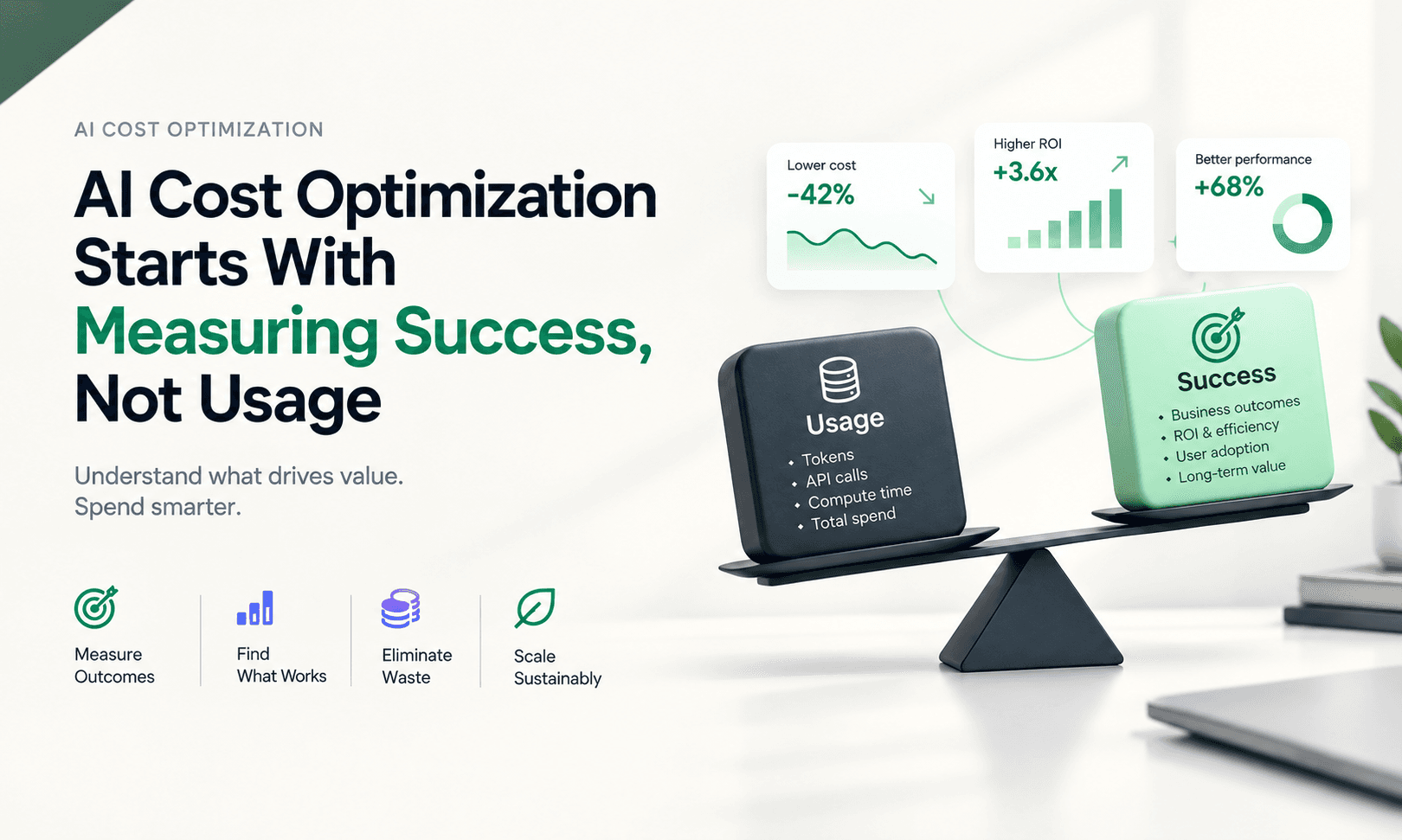
AI costs are easy to calculate. AI value is harder to measure.
Most businesses track token consumption, API calls, and model pricing to understand how much their AI systems cost. These metrics are useful, but they only tell us what we spend on AI, not what we get in return.
A model that costs less per request may produce inaccurate answers, require multiple retries, or send work back to a human for correction. Another model might cost more upfront but complete the same task accurately on the first attempt.
The cheapest AI is not necessarily the most cost-effective. The best AI is the one that delivers the right outcome at the lowest total cost.
This is why businesses need to move beyond cost per token and start measuring cost per successful outcome.
The Problem With Measuring AI Cost Per Token
AI models are becoming more capable and increasingly affordable. Many providers offer low-cost entry tiers, but pricing can change significantly once usage crosses certain thresholds. Higher usage tiers, additional capacity requirements, or different service limits can increase costs, sometimes substantially.
This makes cost estimation more complicated than simply comparing input and output token prices. Token consumption itself is dynamic. The same task can consume different amounts depending on prompt length, conversation history, retrieved context, output length, reasoning requirements, and the number of model calls involved.
There is another overlooked factor: failed calls still cost money. A request that times out, generates an unusable response, or fails validation may consume billable tokens and computing resources without delivering any value. Retrying it adds further cost.
The actual expense goes beyond the price of a successful API call. It includes retries, orchestration, retrieval, validation, infrastructure, and human intervention. Optimizing token consumption alone can make an AI system cheaper to run while making the overall workflow more expensive.
Lower token costs do not automatically translate into lower operating costs.
Measure What AI Successfully Delivers
Cost per successful outcome measures how much a business spends to complete a task to its required standard.
Instead of asking, "How much does this AI request cost?", businesses should ask, "How much does it cost to complete this task correctly?"
The basic formula is:
Cost Per Successful Outcome = Total AI Operating Cost ÷ Number of Successfully Completed Outcomes
For example, imagine an AI system processes 1,000 customer queries at a total cost of $200. If 800 queries meet the required quality standard, the cost per successful outcome is $0.25.
Now consider a second system that processes the same 1,000 queries for $150 but successfully completes only 500. Its cost per successful outcome is $0.30.
The second system is cheaper to run overall, but the first system delivers successful outcomes at a lower cost per task.
This is a simplified example, but it illustrates an important principle: AI efficiency should be measured by useful work delivered, not just computational resources consumed.
The definition of success matters, too. A task should count as successful only when it meets predefined requirements for accuracy, completeness, compliance, and any necessary human approval.
An AI response is not the same as a completed task.
Why Cheaper Models Can Cost More
Model pricing is an important part of AI economics, but it should not be the only factor in model selection.
Three factors can significantly change the real cost of an AI task.
1. Retries and failed calls: A model may generate an incorrect response, fail a validation check, or time out. Even when a call fails, consumed tokens and computing resources may still be billable. Subsequent attempts increase both cost and latency.
2. Human intervention: If an AI system generates a report in seconds but requires significant manual correction, the apparent time savings can be misleading. Teams should track review time, correction rates, and the proportion of tasks that require manual completion.
3. Orchestration and additional processing: Agentic workflows and retrieval-augmented generation (RAG) pipelines may involve multiple model calls, document retrieval, reranking, validation, and fallback logic. Each step adds overhead. These steps are valuable when they improve quality or reliability, but unnecessary complexity can erode cost savings.
The objective is not to eliminate human involvement from every workflow. It is to use human expertise where it adds the most value.
The real cost of AI includes everything required to turn an output into a usable result.
Build a Better AI Cost Measurement Framework
Moving beyond token pricing does not mean abandoning token metrics. It means combining them with performance and operational measures.
1. Cost Per Successful Outcome
Measure the total cost of completing a task to the required standard. Calculate it by workflow, business function, model, or task category. Avoid relying only on an overall average, which can hide expensive or unreliable workflows.
2. Task Success Rate
Track the percentage of attempted tasks that meet predefined acceptance criteria. Success should be determined through appropriate evaluation methods, such as rule-based checks, reference answers, structured validation, or human assessment. A response being generated does not automatically mean the task has been completed successfully.
3. Retry and Failure Rate
Measure how often tasks require additional attempts, fallback models, or complete regeneration. A rising retry rate can indicate poor prompt design, insufficient context, model limitations, or unstable integrations. Reducing unnecessary retries can improve both cost efficiency and latency.
4. Human Intervention Rate
Track the proportion of tasks that require review, correction, or manual completion. Pair this with average review time and rework effort. Together, these metrics reveal whether AI is genuinely reducing workloads or merely shifting them elsewhere.
5. Latency and Throughput
A successful outcome delivered too late may still have limited business value. Measure the time required to complete a task, including retrieval, retries, and validation. Where relevant, include human review time to understand the full end-to-end process. For production systems, track throughput and latency percentiles as well. An acceptable average can conceal a significant number of slow or stalled tasks. Together, these five measures provide a more realistic picture of AI performance than token consumption alone.
Measure the Economics Before Scaling
AI systems that perform well in a pilot may behave differently at production scale.
Real-world workloads introduce more diverse inputs, longer documents, edge cases, concurrent requests, and changing usage patterns. These can increase retries, latency, and infrastructure requirements.
Before scaling an AI workflow, businesses should establish a repeatable evaluation process.
Start with a representative dataset of real tasks. Define what a successful outcome looks like before testing. Then compare alternative models and workflow configurations using the same inputs and acceptance criteria.
For each configuration, record:
- Total operating cost
- Successful completion rate
- Cost per successful outcome
- Average retries per task
- Human review and correction time
- End-to-end latency
Run the evaluation across enough examples to capture meaningful variation, including difficult cases. Then test the system under realistic production conditions.
Continue monitoring the same metrics after deployment because model behaviour, input quality, and workload patterns can change over time. This process helps teams identify whether a cost reduction is genuine or simply the result of accepting lower quality. It also provides a basis for deciding when to change models, revise prompts, simplify orchestration, or introduce additional validation.
Measure performance before scaling, and keep measuring after deployment.
From Token Optimization to Outcome Optimization
AI cost management is entering a different phase. As businesses move from isolated experiments to integrated AI workflows, the largest efficiency gains may come from improving how systems complete tasks rather than simply choosing models with lower token prices.
That means building reliable evaluations, reducing unnecessary retries, routing tasks intelligently, controlling orchestration overhead, and measuring human intervention.
It also means accepting that the lowest-cost configuration is not always the best one. A slightly more expensive system can deliver better economics when it produces more reliable results, reduces rework, and completes tasks faster.
Instead of asking how cheaply a model can generate an answer, ask how reliably the system can complete the work. Instead of tracking only how many tokens are consumed, measure how many tasks are completed correctly. And instead of celebrating lower API bills in isolation, connect AI expenditure to operational performance and business outcomes.
The future of AI cost optimization is not about spending less on every request. It is about spending intelligently to deliver more successful outcomes.