



Mixture of Experts (MoE): How LLMs Get Bigger Without Activating Every Parameter
Mixture of Experts lets large language models use learned expert networks selectively. A trained router sends each token to relevant experts, reducing active computation while preserving broad capacity. Efficiency still depends on memory, communication, and infrastructure.
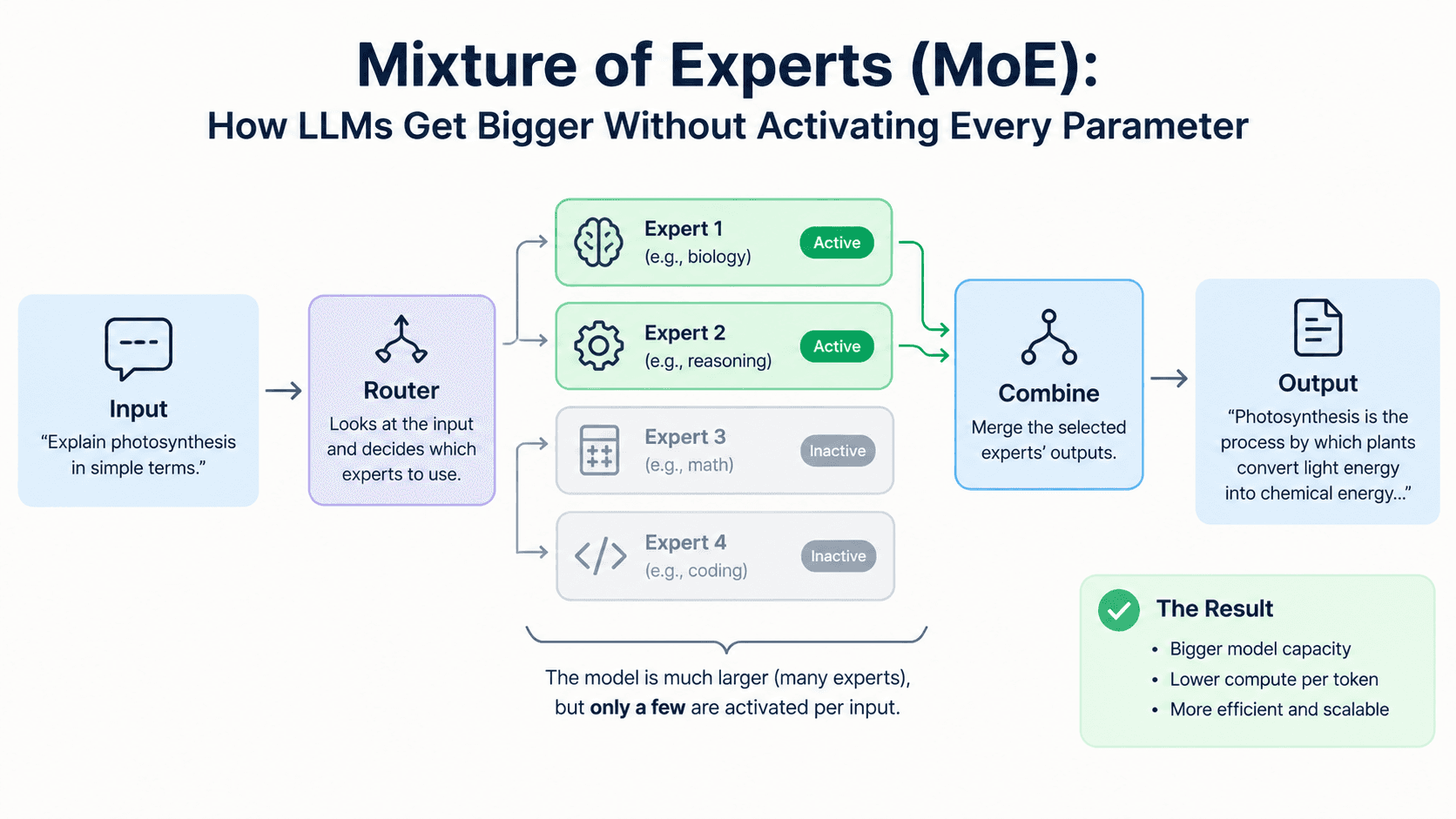
Large language models are growing at a remarkable pace. Some contain hundreds of billions of parameters: the learned values that help a model recognize patterns, understand context, and generate responses. These parameters give a model room to learn complex relationships across language, code, and other data. But a bigger model also needs more computing power to train, more memory to store, and more infrastructure to serve.
The challenge extends beyond building the model. Enterprises must collect, clean, update, and govern huge amounts of training data. Once a model is running, it must find useful patterns in that learned knowledge and respond to requests quickly and reliably. That makes maintaining large models and serving them at scale costly and complex. If every parameter had to participate in every response, the computing demand could grow quickly.
Mixture of Experts, or MoE, offers a different way to scale a model. Instead of using the same full set of parameters for every token, an MoE model has a large pool of learned capacity and activates only a portion of it for each token. The goal is to combine a model’s broad capacity with more selective computation.
What Is an Expert?
In a language model, an expert is typically a neural network module, often a feed-forward network inside a larger Transformer model. An MoE architecture replaces some of the usual dense feed-forward layers with collections of these expert modules.
The word “expert” can sound as though each component has been assigned a clear job, such as “the coding expert” or “the medical expert.” That is usually not how it works. People do not label the experts with subjects in advance. Their parameters are learned as the model trains on data.
During training, different experts become more useful for different kinds of patterns. One may respond more often to certain structures or contexts, while another may be more useful elsewhere. But these roles can overlap, and they are not always easy to interpret. An expert is a learned component that can draw on, not a person-like specialist with a fixed area of expertise.
How the Router Selects Experts
An MoE layer includes a router, sometimes called a gating network. As each token reaches that layer, the router calculates which experts should process it. Depending on the design, it can select one expert or several. The selected experts process the token, and the router combines their contributions before passing the result along to the next layer.
Consider a model responding to:
“Summarize this sales report and explain why revenue fell in the final quarter.”
The model processes the request as a sequence of tokens. At an MoE layer, the router may send different tokens to different combinations of experts. Several experts can contribute to the same response, and the model repeats this process as it reads the prompt and generates an answer.
The selection happens automatically, based on patterns learned during training. A user does not need to specify which expert should handle a request, and the model does not have to select one expert for the entire conversation. Routing can happen at the token level, so different parts of the same prompt may take different paths through the expert layer.
Sparse Activation: A Large Model Uses Part of Itself
In a dense model, the same broad set of parameters is used as the model processes each token. In an MoE model, only a subset of expert parameters is active for each token. This is known as sparse activation.
DeepSeek-V3 is one prominent example. Its technical report describes 671 billion total parameters, with 37 billion activated for each token. The total parameter count describes the model’s overall learned capacity; the active parameter count describes how much of that capacity participates in processing a token.
This does not mean the remaining parameters disappear or are permanently switched off. They are available to the model and may be selected for other tokens. The model’s full capacity is spread across many experts, while each token uses only a portion of them.
That distinction is what makes MoE appealing: it can provide more total model capacity without requiring all expert parameters to run for every token. Sparse expert models have been studied as a way to scale parameter counts while keeping computation per input more controlled. This describes this general approach and the engineering challenges involved.
Why Use a Mixture of Experts?
MoE changes how a model uses its parameters. Rather than having every expert work on every token, it can route each token to a selected group. This can offer several potential advantages:
- More capacity: A model can contain a larger pool of expert parameters and draw on different parts of it as needed.
- Selective computation: Only the selected expert modules run for a given token, which can reduce active computation compared with running every expert.
- Flexible routing: Different tokens can use different experts, so the model is not limited to sending every part of a request through the same expert modules.
These are potential advantages, not automatic guarantees of faster responses, lower total costs, or better answers. Performance depends on the architecture, the hardware, the workload, and how well the serving system handles routing. A model uses fewer expert parameters per token yet still faces costs from memory, communication, attention, and other parts of inference.
MoE also addresses a different problem from data retrieval. It changes which model parameters process a token; it does not, by itself, find a company’s latest document or ensure the model has current information. Systems that need to search external or frequently updated data still require appropriate retrieval, governance, and data pipelines.
What Makes MoE Challenging to Build and Run?
A router alone does not make a model efficient. The model must learn useful routing behavior, and the system running it must move work to the selected experts without adding too much overhead.
Experts need balanced workloads
If too many tokens are routed to one expert while others sit idle, work becomes uneven. The busy expert can slow down the overall process, and unused capacity is wasted. Training methods can encourage the router to distribute tokens across experts. DeepSeek-V3, for example, describes an auxiliary-loss-free strategy designed to help with load balancing.
Experts may be spread across devices
Large models may place their experts on different GPUs or machines. When a token needs an expert located elsewhere, the system must send data to that device and gather the result. This communication overhead can become a bottleneck, especially if the hardware network is not designed to move data efficiently.
The full model still needs memory
Sparse activation can reduce how much expert computation is used for each token, but the system still needs access to the model’s parameters. Different experts may be selected for different tokens, so the overall model’s memory requirements remain important. MoE can save on active computation without making a large model small to store or serve.
Training and serving require careful coordination
The router, expert placement, batch sizes, and serving software all affect performance. Routing can be uneven, and some experts may receive more work than others. Teams must account for these issues while training the model and while handling real requests in production.
That is why MoE is as much an infrastructure achievement as a modeling technique. Its benefits depend on how well the routing, hardware, networking, memory, and serving system work together.
What Enterprises Should Consider
For enterprises, Mixture of Experts (MoE) can be a valuable architecture when applications require the capabilities of a large language model without activating all its parameters for every request. It offers a practical balance between model capacity, computational efficiency, and inference performance, particularly for organisations handling high volumes of AI workloads or complex reasoning tasks.
A few key factors to consider:
- Infrastructure: GPU availability, memory requirements, and deployment complexity.
- Performance: Response latency, routing efficiency, and reliability.
- Cost Efficiency: Overall serving costs compared with dense models.
- Scalability: Ability to handle growing workloads and concurrent requests.
A practical starting point is to pilot MoE on representative enterprise workloads and compare it with dense or smaller models across answer quality, performance, and operating costs. Enterprises should also evaluate data governance, security, and retrieval independently, as MoE does not automatically address these challenges.
Ultimately, MoE should be evaluated as an architectural choice rather than an automatic upgrade. Its real value lies in whether an organisation can achieve the capabilities of a larger model while maintaining acceptable performance, infrastructure costs, and operational reliability.
The Next Scaling Question
For years, progress in AI looked like a single dial labeled size: turn it up, gain more model capacity, and pay for more computing power. Mixture of Experts adds another question: how much of the model needs to work on this token?
The experts are learned during training, and a learned router selects which ones to activate. Depending on the architecture, multiple experts can contribute to the same token or request. This gives model builders a way to combine a large pool of parameters with more selective computation, while giving infrastructure teams new challenges in balancing expert workloads, managing memory, and controlling communication costs.
MoE is not a shortcut around the cost of large models. It is a way to use their capacity more selectively. As language models continue to grow, knowing which parts to activate and when may matter as much as adding more parameters.