



Why Enterprise AI Needs Memory, Monitoring, and Evidence
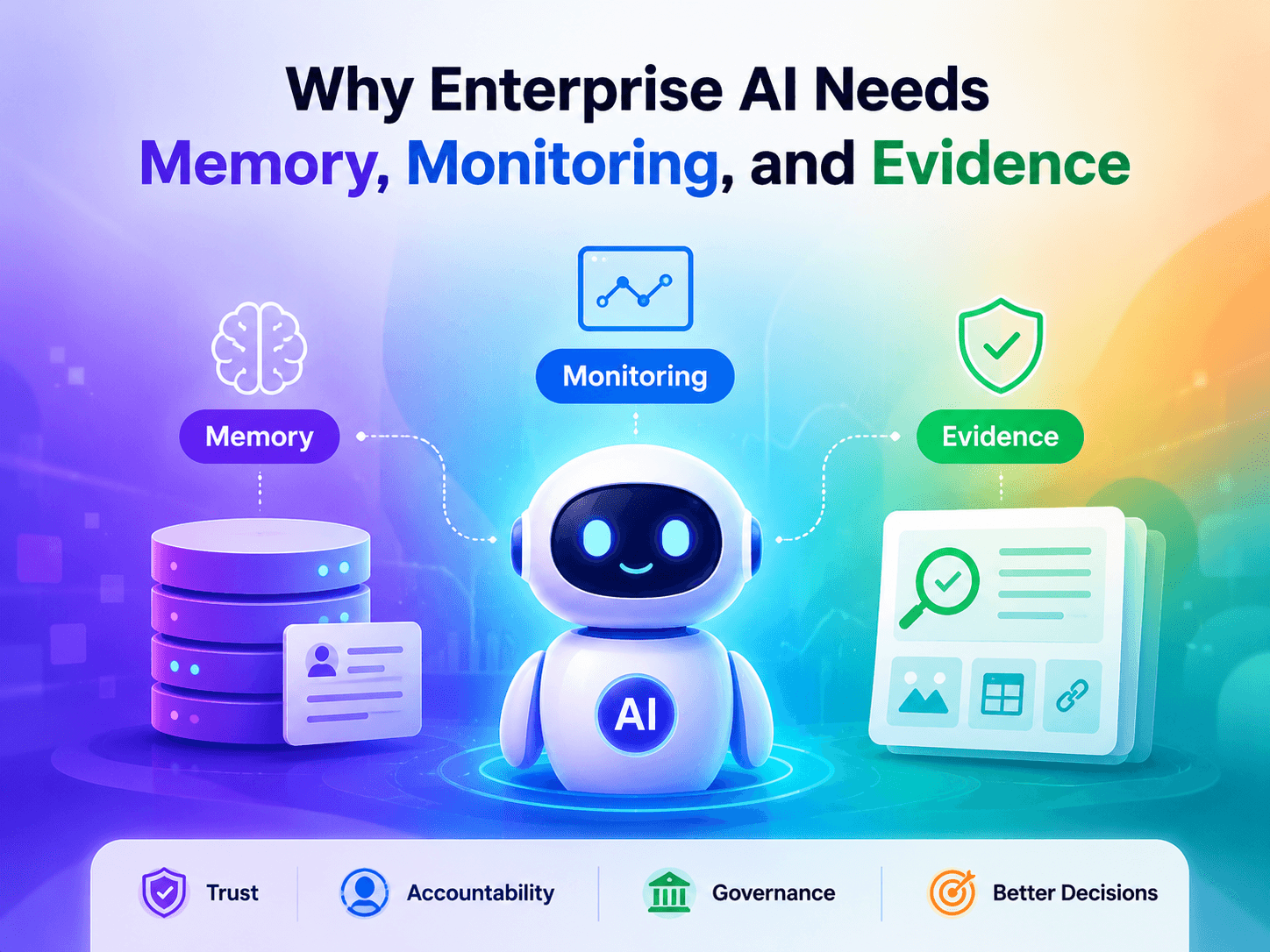
Enterprise AI's biggest risk isn't hallucination. It is confident decision making without transparency. As AI agents become part of critical business operations, organizations need agent tracing to capture data sources, reasoning, and decision paths. Like aviation's flight recorders, AI observability builds trust through evidence, accountability, governance, and reliable decisions.
You've spent days preparing your quarterly board presentation.
The strategic narrative is clear and well-structured. The market analysis looks convincing. The financial projections have been refined with the help of your enterprise AI assistant.
Everything appears ready for the board meeting.
Halfway through the meeting, the CFO pauses on a chart.
"Can we verify these numbers?"
Without hesitation, the AI responds:
"Yes. These figures are based on available company data."
The room moves on. The presentation finishes. Everyone leaves feeling confident.
Three days later, your finance team discovers that the AI merged last quarter's forecast with this quarter's actuals. The recommendation wasn't fabricated. The underlying data existed. The AI simply connected the wrong sources and presented the answer with absolute certainty.
The issue wasn't that the AI made a mistake. The issue was that nobody could answer a much more important question:
- Which data did the AI actually use?
- Why did it choose those sources?
- What assumptions influenced the recommendation?
- Has it made similar mistakes before?
The AI sounded confident. But it left no trail. And that's where enterprise risk begins.
We've Been Solving This Problem for Decades
Interestingly, another industry faced this exact challenge long before AI.
“Aviation”
Airplanes didn't become the safest mode of transportation because pilots suddenly became perfect. They became safer because every flight became observable.
- Flight recorders.
- Cockpit voice recordings.
- Telemetry.
- Maintenance logs.
Every important decision leaves evidence. When an incident happens, investigators don't rely on confidence or memory.
They reconstruct exactly what happened. What decisions were made.
Why were they made? What changed.
And where things started to go wrong.
That level of traceability transformed aviation.
Enterprise AI needs the same transformation.
The Real Problem Isn't Hallucination
For the last two years, conversations around AI have focused heavily on hallucinations.
- Can the model invent facts?
- Can it generate false information?
- Can it make mistakes?
Those are important questions.
But they're no longer the biggest challenge for enterprises deploying AI at scale.
The bigger challenge is confidence without accountability.
Modern AI has become remarkably good at presenting information clearly.
- It writes fluently.
- It explains convincingly.
- It rarely sounds uncertain.
Unfortunately, confidence is not evidence.
An answer can sound professional, logical, and persuasive while still being incomplete, outdated, or based on the wrong context.
Humans are naturally inclined to trust confident answers. This makes overconfident AI one of the most underestimated risks facing modern enterprises.
AI Is No Longer Just Answering Questions
The role of AI has changed dramatically. A year ago, AI primarily generated content.
Today, enterprise AI agents are beginning to:
- Plan projects
- Summarize meetings
- Prioritize tasks
- Recommend strategic decisions
- Generate financial reports
- Analyze competitors
- Coordinate workflows
- Trigger automated actions across multiple systems
In many enterprises, AI is evolving from an assistant into an active participant in business operations.
Once AI starts making decisions that influence people, customers, finances, or strategy, one question becomes unavoidable:
Can we trust its decision-making process?
Trust must extend beyond the output to the reasoning and evidence behind it.
This Is Where AI Agent Tracing Changes Everything
As AI agents become increasingly autonomous, a new enterprise capability is becoming indispensable: AI Agent Tracing.
Just as an aircraft records every important event during a flight, an AI agent should record every meaningful step during its decision-making process.
Instead of only storing the final response, agent tracing captures the journey.
For example, imagine an AI agent preparing a market intelligence report.
Instead of only generating the report, the AI records:
- Which documents it searched
- Which APIs it queried
- Which knowledge base it accessed
- Which prompts were generated internally
- Which tools were called
- What intermediate reasoning steps were taken
- Why certain sources were prioritized
- How the final conclusion was formed
Instead of seeing only the destination, you can see the entire route. That's a fundamentally different level of transparency.
AI Needs Organizational Memory
One of the most valuable outcomes of agent tracing extends far beyond debugging.
It creates institutional memory. Imagine asking your AI:
"Why did we prioritize this customer six months ago?"
Or:
"What changed between last week's recommendation and today's?"
Or:
"Which meeting led to this strategic decision?"
With proper tracing, AI doesn't simply answer.
It reconstructs the complete chain of decisions, actions, and evidence. It becomes the institutional memory of the enterprise.
The Future of Enterprise AI
Over the next few years, enterprises won't compete based solely on who has access to the most powerful language model. Model performance will continue to improve and become increasingly commoditized across the industry.
The real differentiator will be trust infrastructure. Because the future of AI won't be defined by how confidently it speaks.
It will be defined by how transparently it thinks. Trust should never be built on confidence alone; it should be earned through transparency, evidence, and accountability.
Organizations that invest in observability, agent tracing, governance, and human oversight will deploy AI with greater confidence and lower risk.