


Yesterday's Breakthrough Is Today's Baseline
AI innovation is accelerating at an unprecedented pace, with frontier and open-weight models continuously redefining what's possible. Enterprises must move beyond relying on a single model and instead build flexible, model-agnostic AI ecosystems that combine multiple AI strengths to deliver scalable, cost-effective, and future-ready business solutions.
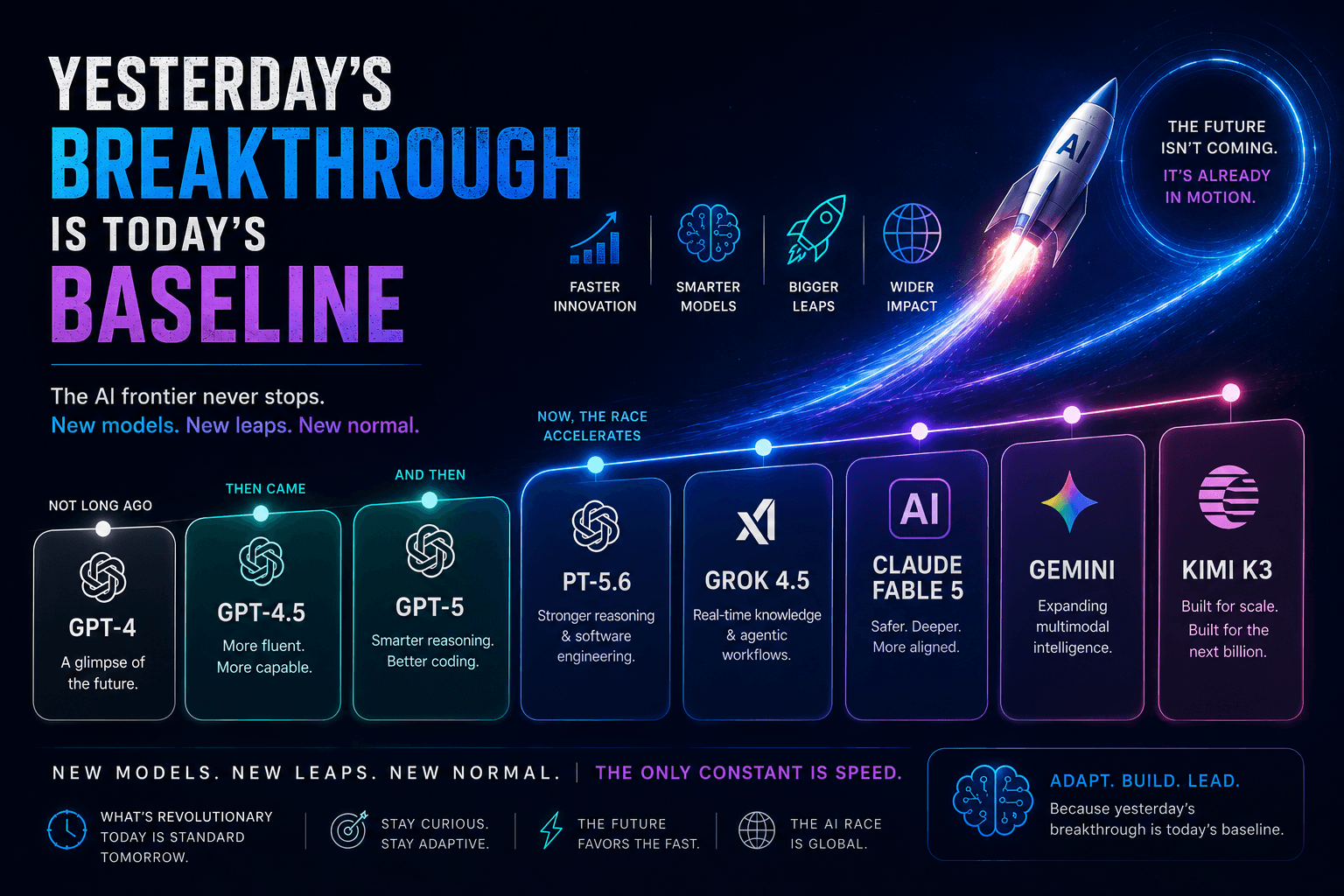
Not long ago, GPT-4 felt like a glimpse into the future.
It could write code, solve complex problems, summarize lengthy documents, and hold conversations that felt remarkably human. For many businesses, it wasn't just another software release. It was the moment AI became real.
Fast forward to today, and that level of intelligence is no longer extraordinary. It's the baseline.
Almost every week, a new model raises the bar. OpenAI introduces GPT-5.6 with stronger reasoning and software engineering capabilities. xAI launches Grok 4.5 with a focus on real-time knowledge and agentic workflows. Anthropic continues to push the boundaries with Claude Fable 5, while Google keeps expanding Gemini's multimodal capabilities. Then comes Moonshot AI's Kimi K3, an open-weight model from China that demonstrates frontier-level performance without the premium price tag typically associated with proprietary AI.
The remarkable part isn't just how capable these models have become. It's how quickly the definition of "best" keeps changing. A benchmark leader today could be challenged next week. A premium model today could face an open-weight alternative tomorrow. What once took years of research and development is now happening in months or even weeks.
This isn't simply healthy competition. It's the fastest innovation cycle the software industry has ever experienced, and it's changing the way enterprises should think about AI.
The AI Race Is No Longer About One Winner
For years, conversations around AI revolved around one question:
"Which model is the best?"
Today, that's the wrong question.
There is no longer a single model that dominates every task. Instead, we're entering an era of specialized intelligence, where different models excel in different areas.
Some are exceptional at complex reasoning. Others shine in coding, scientific research, multimodal understanding, speed, cost efficiency, or long-context analysis. Increasingly, success isn't determined by one universal model. It's about selecting the right model for the right problem.
This is exactly how mature technology ecosystems evolve. Just as organizations don't rely on one programming language, one database, or one cloud service for everything, they shouldn't expect one AI model to solve every business challenge.
Every Model Has Its Strength
One of the biggest shifts over the past year is that AI leadership is no longer defined by a single benchmark. Instead of searching for one model that does everything best, it's becoming more important to understand what each model is built to excel at.
- GPT-5.6 (OpenAI): Excels at complex reasoning, software engineering, structured problem-solving, and advanced coding tasks.
- Claude Fable 5 (Anthropic): Particularly strong in long-context understanding, research, analytical writing, scientific reasoning, and document-heavy workflows.
- Grok 4.5 (xAI): Designed for real-time information access, rapid reasoning, and agentic workflows that interact with live data and external tools.
- Gemini (Google): More than just a standalone model, Gemini is becoming the foundation of Google's AI ecosystem. It's deeply integrated across Search, YouTube, Gmail, Docs, Android, Chrome, Workspace, and other Google products, bringing AI into the daily workflow of billions of users.
- Kimi K3 (Moonshot AI): Demonstrates how open-weight models are reaching frontier-level performance, offering competitive reasoning and coding capabilities with greater deployment flexibility and significantly lower infrastructure costs.
The takeaway isn't that one model has emerged as the clear winner. It's that enterprises now have more choices than ever before. The real competitive advantage lies in understanding the strengths of each model and combining them intelligently, rather than relying on a single AI system for every task.
Open-Weight AI Is Changing the Economics of Intelligence
Perhaps the biggest story of 2026 isn't simply the launch of another frontier model. It's how quickly open-weight AI has matured.
Just a few years ago, open-source models were viewed primarily as research projects. They were useful for experimentation but were rarely considered serious alternatives for enterprise deployments. That perception has changed dramatically.
Models like Kimi K3 are demonstrating that organizations can now access frontier-level capabilities while maintaining greater flexibility over deployment, infrastructure, and costs. This changes the economics of AI.
Instead of relying entirely on premium APIs, enterprises now have multiple deployment options:
- Use proprietary frontier models for highly complex reasoning.
- Deploy open-weight models privately for internal workloads.
- Combine both approaches in a hybrid architecture.
For many organizations, this means lower operational costs, improved data control, and greater freedom to optimize AI systems without being tied to a single provider. Competition isn't making AI more confusing. It's making AI more accessible.
Human-Level Problem Solving Is Becoming the Norm
Modern AI is no longer limited to answering questions or generating text. Today's frontier models are increasingly capable of solving problems that require planning, reasoning, coding, scientific analysis, and multi-step decision-making.
We're seeing AI systems contribute to:
- Complex software development
- Mathematical reasoning
- Scientific discovery
- Research synthesis
- Long-form document analysis
- Autonomous workflows
- Business decision support
In many enterprise settings, AI is evolving from a productivity assistant into a collaborative problem-solving partner.
India Is Ready for the AI Era
India is no longer just one of the world's largest adopters of AI. It's rapidly becoming one of its builders.
Backed by the IndiaAI Mission, investments in GPU infrastructure, AI-ready data centers, and sovereign AI initiatives, the country is laying the foundation for a strong and self-reliant AI ecosystem.
Several Indian companies are leading this transformation:
- Sarvam AI is building large language models and multilingual AI systems designed for Indian languages and enterprise use cases. Its work with government initiatives is helping shape India's AI infrastructure.
- Krutrim AI is developing indigenous foundation models and AI infrastructure, with a vision of creating a complete AI stack built in India.
- Yellow.ai continues to expand enterprise-grade conversational AI and customer experience automation for businesses across the world.
India's biggest advantage is its scale. With over 1.47 billion people, one of the world's largest internet populations, millions of developers, rapidly expanding data centers, and a fast-growing AI user base, the country has the ingredients to become a global AI powerhouse. The next wave of AI won't be built by one nation alone, and India is well positioned to play a defining role in shaping its future.
The Biggest Mistake Enterprises Still Make
Despite rapid progress, many organizations continue approaching AI as though they're purchasing traditional enterprise software.
The strategy often looks like this:
- Select one vendor.
- Standardize on one model.
- Build every workflow around it.
That approach may have worked for ERP systems or cloud platforms. It won't work in the AI era.
Technology is evolving far too quickly. Choosing one model and expecting it to remain the best for years is becoming increasingly unrealistic. Instead, forward-thinking organizations are designing model-agnostic AI architectures.
Rather than locking themselves into one provider, they build systems that can intelligently choose the most suitable model based on the task. A customer support workflow might prioritize speed and cost. A legal assistant may require stronger reasoning. A software engineering workflow might benefit from another model entirely. An internal knowledge assistant could run securely on an open-weight model within the organization's own infrastructure.
The competitive advantage no longer comes from owning one powerful model. It comes from knowing how to orchestrate many of them.
The Future Belongs to AI Ecosystems, Not Individual Models
The biggest shift happening today isn't about who wins the benchmark race.
It's about how enterprises build with AI.
Tomorrow's enterprise AI platform won't depend on one foundation model.
It will combine multiple frontier models, open-weight models, specialized agents, enterprise knowledge, governance frameworks, and human expertise into a single intelligent ecosystem.
The goal isn't to find the perfect model. The goal is to build systems that can continuously adapt as better models emerge. That's a much more sustainable strategy.
Final Thoughts
The AI industry has reached a fascinating point.
Every major release pushes the boundaries of what machines can do. Frontier models continue solving increasingly human-level problems, while open-weight alternatives are rapidly closing the performance gap and making advanced AI more affordable than ever before.
For enterprises, this isn't a race to pick a winner. It's an opportunity to rethink how intelligence is delivered across the organization.
The companies that lead over the next decade won't necessarily be the ones with early access to the latest model. They'll be the ones that build flexible, model-agnostic AI platforms, combine the strengths of multiple models, keep humans involved where judgment matters, and prioritize governance, traceability, and measurable business outcomes over leaderboard rankings.
Yesterday's breakthrough is today's baseline. Tomorrow's breakthrough is already being trained.
The real question is no longer whether AI will change your business. It's whether your AI strategy is evolving as quickly as the technology itself.
Partner with M37Labs to build the next generation of enterprise AI solutions and stay ahead of the innovation curve.