



Jev + LLMs: Why AI Agents Need a Dedicated Decision Layer
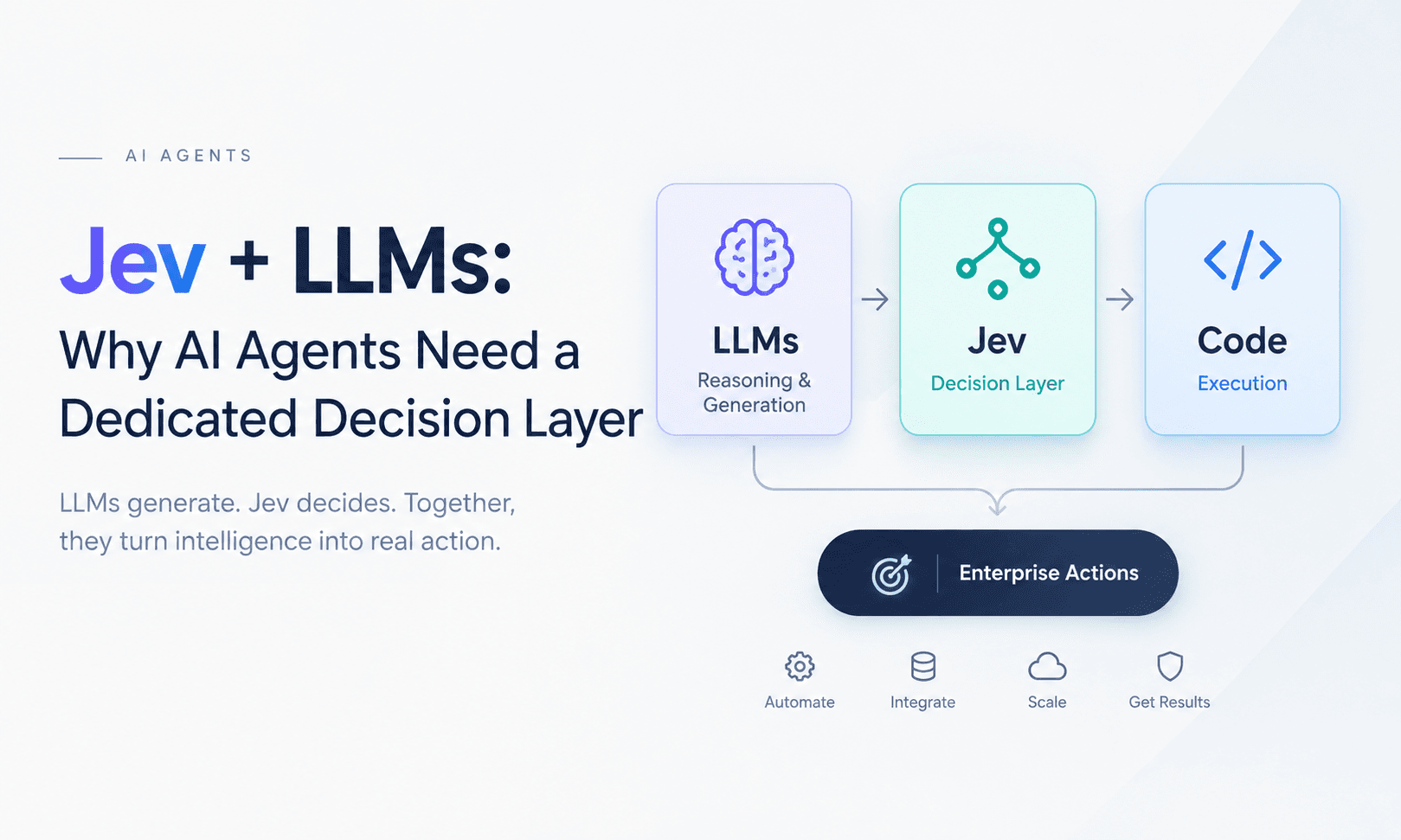
Jev adds a dedicated decision layer to AI agents, separating reasoning, decisions, and execution. LLMs handle intelligence and generation, Jev produces typed decisions and probabilities, while code controls workflows, improving predictability and operational reliability.
For the last few years, the default approach to building AI applications has been simple: give the problem to an LLM.
Need to understand a document? Use an LLM.
Need to classify something? Use an LLM.
Need to choose a tool? Use an LLM.
Need to decide whether a task is complete? Use an LLM.
It works remarkably well. But as AI moves deeper into real business workflows, a new challenge becomes impossible to ignore.
Not every AI problem is about language. Some are about making the right decision.
This is where Jev introduces a different layer for AI systems. Instead of generating text, it is designed to produce typed decisions and probabilities that application code can act on directly.
The architecture becomes simple:
LLM = reasoning and generationJev = decision-makingCode = execution
The answer is not replacing the LLM. It is knowing where the LLM belongs, and giving it the right role.
The Problem With Asking an LLM to Decide Everything
LLMs are extremely good at language. They can understand emails, summarize documents, extract context, reason about a request, generate plans and communicate results.
The challenge starts when that reasoning needs to become an operational decision.
Imagine an AI system handling a refund request.
An LLM might respond:
"Based on the available information, this appears to be a valid duplicate charge and the refund should probably be approved."
A person can understand that. A payment system cannot execute it. The application needs something much simpler:
Approve. Reject. Human review.
That is the difference between generating an answer and making a decision.
The same problem appears across enterprise AI.
- Should this transaction be approved?
- Is this customer issue urgent?
- Is this document compliant?
- Should this incident be escalated?
These are bounded choices. And bounded choices need bounded outputs.
Jev Is Not Another LLM
Jev is not trying to become another general-purpose conversational model. Its job is narrower.
Make a decision that software can use.
Instead of:
"This appears to be a high-priority customer issue and I would recommend escalating it."
A decision-oriented system can return:
Priority: HighProbability: 0.91
The first is written for a human. The second is designed for software.
That distinction becomes important when AI moves from chat interfaces into production workflows.
Typed Outputs Change the Interface
One of the most important ideas here is typed output.
With an LLM, we can ask for JSON:
{
"decision": "approve",
"confidence": 0.92
}
It looks structured, but the LLM is still generating the output. And you cannot truly stop an LLM from generating, because generation is what it is designed to do.
It could just as easily produce:
{
"decision": "probably approve",
"confidence": "pretty high"
}
Now the application has to figure out what that means. A typed decision system starts from the other direction. The possible outputs are defined first:
Approve. Reject. Human review.
The system chooses between known possibilities instead of inventing new ones.
That gives software a much cleaner contract. The application knows what the outputs mean. It knows what can happen next. Less interpretation. More control.
Probabilities Add Another Layer
A decision alone is not always enough. Consider a risk assessment system.
It could return:
High Risk
But the application may also need to understand how strongly the system supports that decision.
For example:
- Low Risk: 0.03
- Medium Risk: 0.17
- High Risk: 0.80
Now the application has a signal it can use. A high-confidence decision could move automatically. A lower-confidence decision could be monitored. An uncertain case could go to a human.
This is an important separation of responsibility. The model provides the signal. The software defines the policy.
The business decides what confidence threshold is acceptable. That threshold could be 0.95 for a financial transaction and 0.70 for an internal content workflow.
The model should not decide its own authority.
So Where Does the LLM Fit?
It stays. Jev is not a replacement for an LLM. The two solve different problems.
Consider a corporate communications system where a user asks:
"Analyze the latest news about our company and prepare a crisis response."
There are several layers hidden inside that request. The LLM can understand the request, analyze documents, interpret news and gather context.
Then the system reaches a set of bounded decisions:
- Is this potentially a crisis?
- What category does it belong to?
- Does the evidence meet the escalation threshold?
- Should a human review it?
- Which workflow should run?
This is where a dedicated decision layer can fit. Once the decision is made, conventional software can execute the workflow. Then the LLM can come back into the process. It can prepare the executive briefing.
- Draft the media response.
- Generate talking points.
- Summarize the outcome.
The LLM handles intelligence and expression. Jev handles bounded decisions. Code handles execution.
A Different Architecture for AI Agents
The next generation of enterprise AI will not be about one model doing everything. It will be about giving different systems different jobs.
- LLM for intelligence and expression.
- Jev for decisions.
- Code for control and execution.
The LLM understands the problem. Jev chooses between defined outcomes. Code makes it happen. This creates a more explicit boundary between thinking, deciding and acting.
And that boundary matters. Enterprise systems need predictable schemas, auditability, thresholds, permissions, human escalation, repeatability, latency control and cost control.
Trying to make one generative model handle every step can make those requirements harder to manage.
A dedicated decision layer introduces another primitive:
AI that makes decisions for software, not just text for humans.
Why This Could Matter for Enterprise AI
For a long time, we asked:
"What can the model generate?"
The more important question for enterprise AI will be:
"What should the model decide, and what should software control?"
That is the architectural shift. AI does not have to own the entire workflow.
I can understand it. It can reason. It can decide.
And then it can hand control back to software.
LLMs make AI expressive. Decision systems make AI operational. Code makes it reliable.
The future of AI agents is not one giant model trying to do everything. It is a system where every layer has a clear and deliberate role.