



The Science of Expert Routing: Exploring Load Balancing Mechanisms in MoE Models
Explore how expert routing and load-balancing mechanisms make Mixture of Experts (MoE) models more efficient. Understand Auxiliary Loss, Router Z-Loss and DeepSeek's Auxiliary-Loss-Free approach, and discover their importance for scalable enterprise AI.
Imagine an organisation with hundreds of specialised employees. Each department handles a different responsibility. Finance handles financial operations, engineering builds products, and research explores new possibilities.
Now imagine sending every task to every employee, regardless of their expertise.
It would be inefficient, expensive, and difficult to manage. This is exactly the problem that Mixture of Experts (MoE) architectures aim to solve in large language models.
Instead of activating the entire neural network for every incoming token, MoE models dynamically select a small group of specialised neural networks, known as experts, to handle the computation. This allows models to increase their total parameter capacity while keeping computational requirements relatively efficient.
But this introduces another challenge: Who decides which expert handles which token, and how do we ensure that some experts are not overloaded while others remain idle?
This is where expert routing and load balancing become essential.
Understanding Expert Routing in MoE Models
Traditional Transformer architectures use dense computation, where every token passes through the same feed-forward network layers.
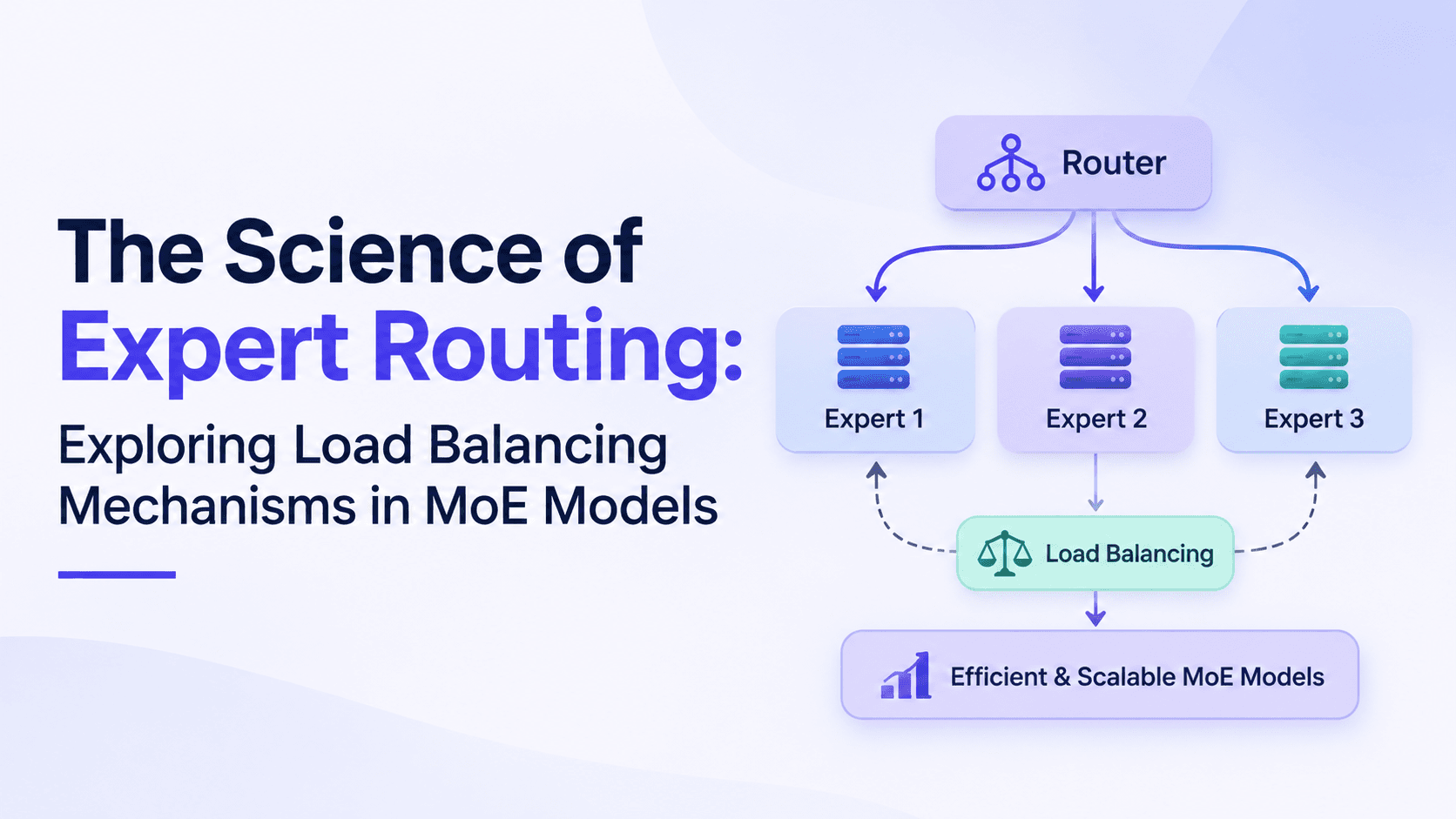
MoE architectures take a different approach. They replace selected feed-forward layers with multiple expert networks and introduce a router that decides where each token should go.
The process involves three key components:
- Router: Evaluates incoming tokens and assigns them to the most suitable experts.
- Experts: Specialised neural networks that process the tokens assigned to them.
- Gating Mechanism: Determines how the selected experts' outputs are combined.
For example, in a model with eight experts using Top-2 routing, the router selects only two experts for each token instead of activating all eight.
This reduces unnecessary computation and allows different experts to develop specialised capabilities.
However, routing decisions are not always evenly distributed. Some experts may receive a significantly higher number of tokens than others. This creates workload imbalance, GPU underutilisation, communication bottlenecks and, in extreme cases, expert collapse.
The challenge is not simply activating fewer parameters. It is ensuring that the available computational capacity is used effectively.
The Three Mechanisms Behind Load Balancing
As MoE architectures scale, researchers have developed different techniques to maintain balanced expert utilisation. Three important approaches are Auxiliary Load-Balancing Loss, Router Z-Loss and Auxiliary-Loss-Free Load Balancing.
1. Auxiliary Load-Balancing Loss: Keeping Experts Utilised
One of the earliest approaches to managing expert distribution is Auxiliary Load-Balancing Loss, popularised by the Switch Transformer architecture. The idea is simple: if the router consistently sends too many tokens to a few experts, the training process should discourage this behaviour.
The mechanism introduces an additional balancing objective during training. It considers two factors:
- How many tokens are actually assigned to each expert.
- How much routing probability the router gives to each expert.
By considering both, the model receives an additional learning signal that encourages more balanced token distribution. This helps prevent a situation where a few experts dominate computation while others receive very little training.
However, there is a trade-off. If the balancing objective is too strong, the router may prioritise equal distribution over selecting the most suitable experts for individual tokens. The objective is to encourage balanced utilisation without limiting the model's ability to specialise.
2. Router Z-Loss: Keeping Routing Stable
Balanced workloads alone do not guarantee stable training. Another challenge occurs when the router produces excessively large numerical values, known as logits, before converting them into probabilities.
These values influence how strongly the router prefers one expert over another. When they grow excessively, they can introduce numerical instability, particularly in large-scale training environments using lower-precision computation.
Router Z-Loss, explored in ST-MoE research, addresses this problem. Rather than directly controlling how many tokens each expert receives, it regularises the router's numerical behaviour and discourages excessive growth in its output values.
Its benefits include:
- Improved numerical stability during training.
- Reduced risk of numerical overflow.
- More reliable router behaviour in mixed-precision environments.
- Better stability when scaling sparse expert architectures.
An important distinction is that Router Z-Loss does not directly balance expert workloads. It complements load-balancing techniques by addressing a different problem.
3. Auxiliary-Loss-Free Load Balancing: A Smarter Way to Distribute Work
Traditional balancing methods introduce an additional loss objective into the training process. But this can create a conflict between balanced expert utilisation and the model's primary learning objective.
DeepSeek-V3 demonstrated another approach: Auxiliary-Loss-Free Load Balancing.
Instead of relying primarily on an additional balancing penalty, it uses dynamically adjusted expert-specific bias values to influence routing decisions.
The mechanism continuously monitors expert workloads:
- When an expert receives too many tokens, its selection bias is reduced.
- When an expert receives too few tokens, its selection bias is increased.
- These adjustments influence future routing decisions and help distribute workloads more effectively.
An important detail is that these bias values influence expert selection, not the final gating weights used to combine expert outputs. This allows the model to manage workload distribution while retaining the router's original affinity scores for computing expert contributions.
The approach reduces dependence on conventional batch-level auxiliary balancing loss and helps preserve the relationship between expert specialisation and the model's primary learning objective.
DeepSeek-V3 also uses a small sequence-level auxiliary balancing loss, so auxiliary-loss-free does not mean that every balancing objective is eliminated. The larger idea is that expert distribution can be managed through an adaptive feedback mechanism rather than relying entirely on additional training penalties.
Why Expert Routing Matters for Enterprise AI
Expert routing is not just a model-training optimization. It directly influences the cost, performance and scalability of AI infrastructure.
As enterprises move towards larger language models, computational efficiency becomes increasingly important.
Poorly balanced routing can create several operational challenges:
- Higher infrastructure costs: Underutilised GPUs and overloaded experts can reduce the value obtained from expensive compute resources.
- Increased latency: A single overloaded expert can delay the completion of an entire distributed training step.
- Scaling limitations: Uneven workloads and communication overhead can make it harder to scale models across multiple GPUs.
- Training inefficiency: Poor expert utilisation can prevent models from making effective use of their available capacity.
For enterprises building or deploying specialised AI systems, these considerations have practical implications.
For example, a financial institution developing a domain-specific language model may use MoE architectures to handle different types of financial information. Different experts could learn patterns relevant to financial reporting, compliance, customer communication and risk analysis.
Similarly, a manufacturing enterprise could explore specialised expert pathways for equipment documentation, predictive maintenance and operational intelligence.
These are potential architectural applications, not automatic expert-to-department mappings. The actual specialisation must emerge through model training and be validated through evaluation.
Enterprises can benefit from these advancements in two ways: adopting efficient MoE-based models through APIs or self-hosted deployments, and developing customised architectures where their scale, data requirements and workloads justify it.
How M37Labs Approaches Efficient AI Architecture
At M37Labs, we believe that building enterprise AI is not just about selecting the most powerful model. It is about engineering the right architecture around business requirements, computational resources and long-term scalability.
Our AI research and development approach explores both proprietary and open-source model architectures, with a focus on practical deployment, performance optimisation and infrastructure efficiency.
This includes:
- Model Research: Exploring architectures such as Mixture of Experts and Small Language Models to identify efficient approaches for enterprise workloads.
- Custom Model Development: Building and adapting specialised models based on organisational requirements, data and deployment constraints.
- Infrastructure Optimisation: Evaluating GPU utilisation, model performance, inference costs and deployment configurations.
- Enterprise Deployment: Taking AI systems from experimentation and prototyping to production environments across cloud and on-premise infrastructure.
The objective is to make AI more than a capable technology. It should be reliable, efficient and economically practical for the organisations using it.
Conclusion: Intelligence Needs Efficient Coordination
The evolution of AI is no longer just about building larger models with more parameters. It is about making better use of the intelligence and computational capacity already available.
Mixture of Experts architectures demonstrate this shift by activating specialised networks only when needed. But their effectiveness depends on how intelligently tokens are distributed.
Auxiliary Load-Balancing Loss encourages balanced expert utilisation. Router Z-Loss improves numerical stability. Auxiliary-Loss-Free Load Balancing introduces a more adaptive way to manage expert workloads.
Together, these techniques address some of the fundamental challenges of scaling sparse neural networks.
As enterprises adopt increasingly sophisticated AI architectures, the ability to balance performance, computational efficiency and infrastructure costs will become a significant differentiator.
The next generation of AI will not be defined simply by how much a model can compute, but by how intelligently it distributes that computation.
At M37Labs, we continue to explore and engineer the architectures that make enterprise AI more scalable, efficient and ready for real-world applications.